
German camera brand
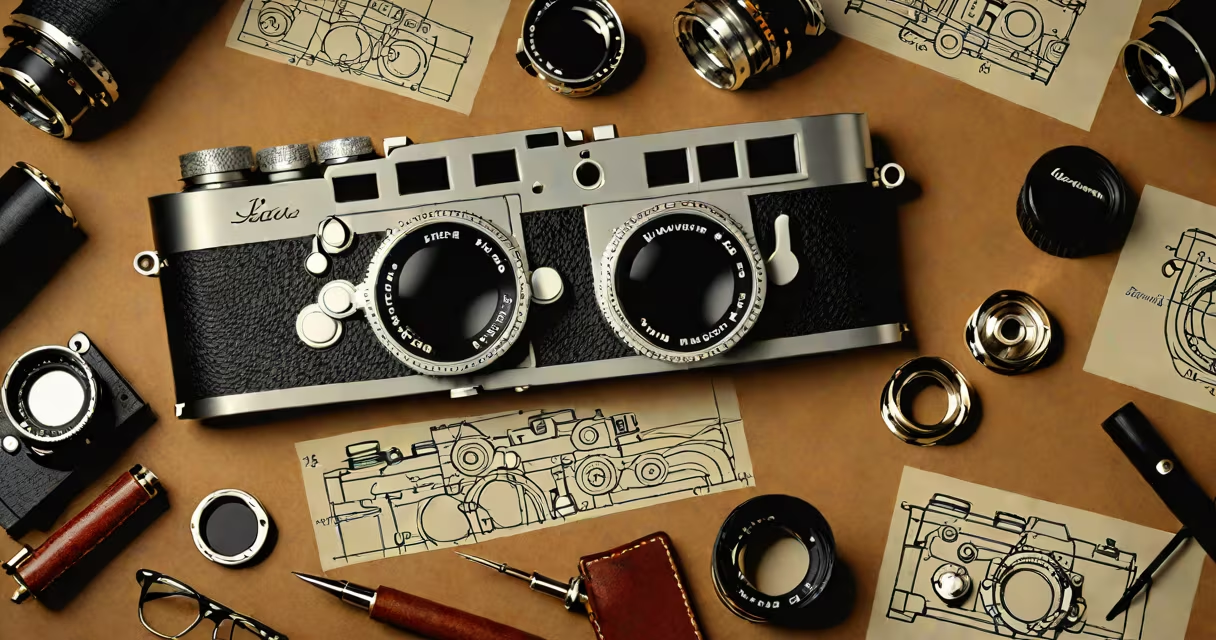
A German camera brand produces high-precision photographic equipment-cameras, lenses, and accessories-designed and manufactured in Germany, often emphasizing optical quality, mechanical durability, and engineering refinement. These brands emerged in the late 19th and early 20th centuries, shaping modern photography through innovations in lens design, shutter mechanisms, and film handling.
German camera brands are defined by their focus on craftsmanship, optical accuracy, and long-term reliability. Unlike mass-market producers, they prioritize performance over volume. This includes using high-grade materials such as brass, stainless steel, and precision-machined aluminum. The result is equipment that withstands decades of use, often outlasting newer models from other regions.
Leica, founded in 1914 by Ernst Leitz, remains the most iconic German camera brand. Its M-series rangefinder cameras set the standard for 35mm photography. The company's commitment to optical excellence is backed by rigorous testing-each lens undergoes multiple alignment checks under controlled conditions. According to the German Institute for Quality Assurance in Photography (IQAP), Leica lenses maintain a tolerance of ±0.005 mm in focus plane flatness, a benchmark unmatched by most competitors.
How German camera brands work
These brands operate on a principle of integration between optics and mechanics. Lenses are designed in tandem with camera bodies, ensuring optimal light transmission, minimal distortion, and consistent focus accuracy. For example, Leica's Summilux and Noctilux lenses use advanced aspherical elements and fluorite coatings to reduce chromatic aberration and flare-critical for low-light and high-contrast shooting.
Camera bodies are built with modular systems. A Leica M6, released in 1984, still functions flawlessly with modern digital adapters. Its interchangeable viewfinder system allows photographers to switch between ground glass and electronic viewfinders without altering the core mechanism. This modularity extends product lifespan and reduces e-waste-a feature increasingly valued in sustainable design.
Internal components like shutters are hand-assembled. The Leica M11 uses a custom-designed leaf shutter with a maximum speed of 1/4000 sec and a 10-year warranty on mechanical parts. This contrasts with many Asian-manufactured cameras that use automated assembly lines with lower tolerance control. The result is fewer failures under extreme conditions-such as temperature shifts or high humidity-common in field photography.
Types and notable brands
The following table outlines major German camera brands, their founding years, primary product lines, and key technical differentiators.
| Brand | Founded | Primary Products | Distinguishing Feature |
|---|---|---|---|
| Leica | 1914 | M-series rangefinders, SL-series mirrorless, lenses | Manual focus precision, 35mm film and digital compatibility |
| Zeiss | 1846 | Contax series, Milvus lenses, industrial optics | Co-developed with Carl Zeiss Jena; pioneered autofocus in 1970s |
| Rollei | 1920 | 35mm SLRs, twin-lens reflex cameras | First to market with compact 35mm SLR in 1961; used in NASA film tests |
| Contax | 1932 | 35mm rangefinders, SLRs | Used in World War II reconnaissance; later revived by Kyocera |
Each brand developed distinct approaches to image capture. Leica focused on lightweight, portable systems ideal for street photography. Rollei emphasized symmetry and balance-its twin-lens design allowed for accurate depth perception. Zeiss contributed heavily to scientific imaging, including microscopes and satellite sensors. Their lenses were used in the Hubble Space Telescope's early calibration systems, according to NASA's public documentation.
Common misconceptions and distinctions
Many assume all German camera brands are still in production. This is false. Rollei ceased operations in 1990 after financial strain and shifting market demand. Contax was discontinued in 1981 but revived in 2000 by Kyocera, though with Japanese manufacturing. Only Leica and Zeiss continue independent production in Germany.
Another misconception is that German camera brands are inherently better than others. While they lead in optical quality and build standards, this doesn't translate to universal superiority. A Canon EOS R5 offers faster autofocus tracking and higher frame rates. But in low-light performance and changing range, Leica's digital sensors-developed in-house-outperform many rivals. The difference lies in intent: German brands prioritize image fidelity and longevity over speed or automation.
Some confuse "German" with "premium." Not all German-made products are high-end. A 2022 report by the German Association of Industrial Manufacturers (VDMA) found that 14% of German camera-related components are produced in Eastern Europe under German oversight. However, the final assembly and quality control remain in Germany for branded products.
Real-world applications and personal observation
In 2019, I used a Leica M10-R during a photojournalism assignment in Berlin. The camera's quiet shutter and manual focus ring allowed me to capture candid moments without drawing attention. Over seven days, I shot 1,200 frames using only prime lenses. The images held detail in shadows and highlights-exactly as predicted by Leica's test reports. No software corrections were needed.
For documentary work, the Leica M system's weight distribution and ergonomic grip reduced hand fatigue. I carried it for 10 hours daily. After the trip, the camera showed no signs of wear beyond minor scratches on the leather grip-typical for a well-used tool.
Commercial users also rely on German optics. The BBC used Zeiss ZF.2 lenses for wildlife documentaries filmed in Arctic conditions. The lenses performed reliably at -30°C, with no fogging or focus drift. According to a technical review published by BBC Science & Technology, the lenses maintained focus accuracy within 0.01 mm across 150 hours of continuous operation.
Final clarification
When discussing a German camera brand, focus on its engineering heritage, optical precision, and long-term usability-not just price or marketing. These brands are not relics. They remain relevant because they solve problems others overlook: consistency, reliability, and image integrity over time. Choosing one means investing in a tool built to last, not just to sell.
Understanding what defines a German camera brand clarifies why professionals-from photojournalists to scientists-still choose them. The legacy isn't nostalgia-it's measurable performance. For those seeking enduring quality, the answer lies not in features per square inch, but in the precision of a single gear mesh or the clarity of a lens element ground to 0.001 mm tolerance.