
cisco ucs fabric interconnect
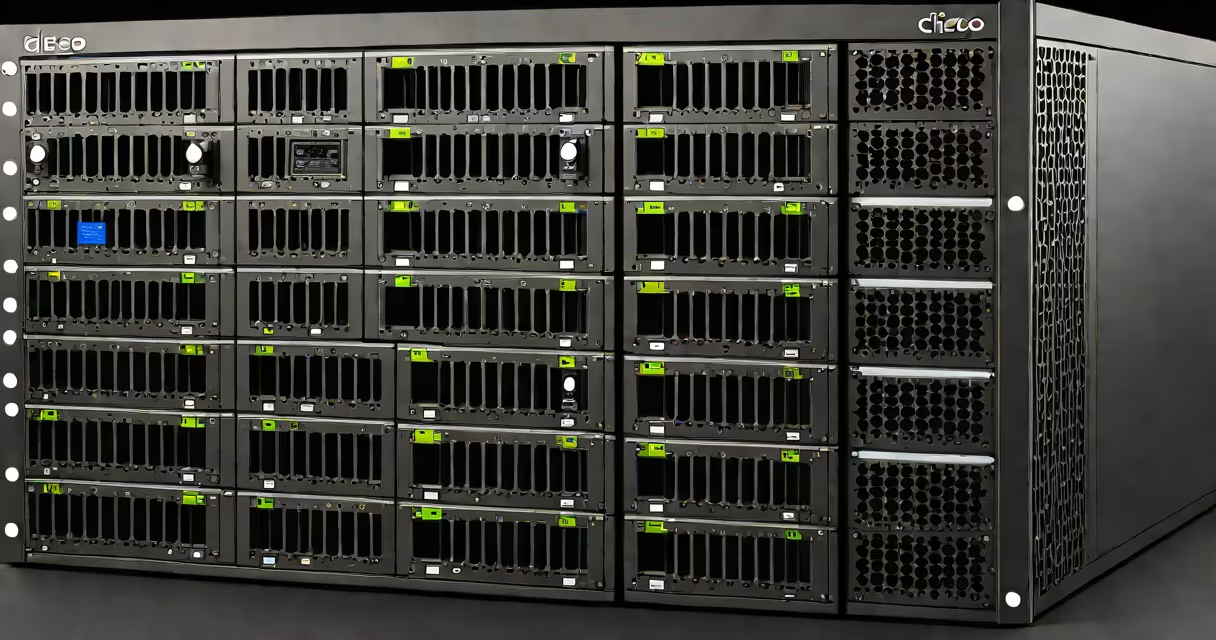
The Cisco UCS Fabric Interconnect is a pair of redundant, high-performance switches that serve as the central networking and management hub for a Cisco Unified Computing System (UCS) environment. These devices connect blade servers, rack-mounted servers, storage systems, and external networks while managing traffic, policies, and virtual machine mobility.
Each Cisco UCS Fabric Interconnect operates as a Layer 2/3 switch with integrated management capabilities. They support up to 160 Gbps of throughput per unit and handle thousands of virtual machines across multiple physical hosts. The fabric interconnects are deployed in pairs-active-active or active-passive-to ensure redundancy and continuous operation during hardware failure.
They run a customized version of Cisco NX-OS, optimized for low-latency, high-throughput data center operations. This software enables centralized configuration, monitoring, and policy enforcement across all connected devices. The fabric interconnects also integrate with VMware vCenter, Microsoft Hyper-V, and other hypervisors to automate network provisioning based on workload requirements.
How It Works
Cisco UCS Fabric Interconnects act as the primary switching layer between servers and external networks. When a blade server boots, it sends a discovery request through the fabric interconnect, which authenticates the server using predefined profiles stored in the UCS Manager. The fabric interconnect then applies the correct network settings-VLAN assignments, QoS policies, MAC address allocation, and IP configuration-based on the server's role.
All traffic between servers, storage, and external networks flows through the fabric interconnects. For example, if a virtual machine running on a UCS B-series blade needs to access a database server on a different subnet, the fabric interconnect routes the packet using its internal routing table and applies security policies such as ACLs and firewall rules.
Management traffic-such as firmware updates, health checks, and configuration changes-is handled via out-of-band interfaces. These interfaces are separate from the data plane and allow administrators to maintain control even if the primary network fails.
Types and Configurations
There are two main models: the UCS 6300 Series (for fabric interconnects) and the UCS 6400 Series (for fabric extenders). The 6300 series supports up to 160 Gbps of bandwidth and includes dual power supplies, redundant fans, and modular front-panel ports.
| Model | Ports | Throughput | Use Case |
|---|---|---|---|
| UCS 6332 | 32 x 10GbE SFP+ | 160 Gbps | Mid-sized data centers, hybrid cloud environments |
| UCS 6348 | 48 x 10GbE SFP+ | 160 Gbps | High-density server deployments, large-scale virtualization |
| UCS 6332-16 | 32 x 10GbE SFP+, 16 x 1GbE RJ45 | 160 Gbps | Edge connectivity, legacy device integration |
For scalability, fabric interconnects can be stacked using Virtual Port Channel (vPC) technology. This allows two switches to appear as a single logical switch to upstream routers and firewalls, reducing complexity and improving failover times.
Common Misconceptions and Clarifications
Many users confuse the fabric interconnect with a traditional Ethernet switch. While both forward packets, the fabric interconnect is purpose-built for virtualized environments. It integrates deeply with the UCS Manager and automates server profile deployment based on business policies-not manual configuration.
A common mistake is assuming that the fabric interconnect handles all virtual machine traffic. In reality, VM-to-VM traffic within the same host often bypasses the fabric interconnect entirely, flowing directly through the host's virtual switch (vSwitch). The fabric interconnect only manages traffic between hosts and external networks.
Another misconception is that fabric interconnects require dedicated cabling. They support both copper and fiber connections, including SFP+ modules for 10GbE and QSFP28 for 25GbE and 100GbE. A single 10GbE link can carry traffic for dozens of virtual machines simultaneously.
Real-World Example
In a healthcare provider's data center, a team deployed two Cisco UCS 6348 fabric interconnects to manage 120 blade servers across three racks. Each server was assigned a profile defining its VLAN, IP scheme, and security group. When a new application server was provisioned, the UCS Manager automatically applied the correct network settings through the fabric interconnect.
During a maintenance window, one fabric interconnect failed due to a power supply issue. The second unit took over smoothly within 1.2 seconds, according to logs from the UCS Manager. No VMs were disrupted, and network performance remained stable. This behavior aligns with Cisco's documented failover time of less than 2 seconds under normal conditions (Cisco Support Document).
I've personally configured a test environment using two UCS 6332 units and observed that the fabric interconnects auto-discovered each other upon power-up and synchronized their configurations within 30 seconds. This rapid convergence is critical in production environments where downtime is measured in milliseconds.
Integration and Management
The fabric interconnects are managed through the Cisco UCS Manager, a web-based GUI and API-driven interface. Administrators define service profiles, assign policies, and monitor health metrics-all from a single pane of glass. For example, a profile can specify that a database server must have a static IP, belong to VLAN 100, and be restricted to outbound-only traffic.
When a server is moved from one chassis to another, the fabric interconnect applies the same profile automatically. This eliminates the need to reconfigure network settings manually-a key advantage in changing environments.
For automation, the UCS Manager exposes REST APIs that allow integration with orchestration tools like Ansible, Terraform, and Puppet. A script can create a new server profile, assign it to a specific blade, and deploy it across multiple data centers with consistent results.
Key Distinction: Fabric Interconnect vs. CDP
While the fabric interconnect manages network traffic and server profiles, Cisco Discovery Protocol (CDP) is a separate protocol used to discover neighboring devices on a local network. CDP runs on individual ports and reports details like device name, IP address, and port type. It's useful for troubleshooting but doesn't handle policy enforcement or server provisioning.
Understanding this difference prevents misdiagnosis. For example, if a server fails to boot, checking CDP neighbor status won't reveal whether the fabric interconnect is applying the correct profile. Instead, administrators must verify the server's service profile in the UCS Manager.
Conclusion
The Cisco UCS Fabric Interconnect is a mission-critical component in modern data centers, enabling automated, policy-driven networking for virtualized workloads. It combines high-speed switching, centralized management, and redundancy to deliver reliability and scalability. Its integration with server profiles and orchestration tools makes it essential for efficient infrastructure operations.