
insurance institute for highway safety
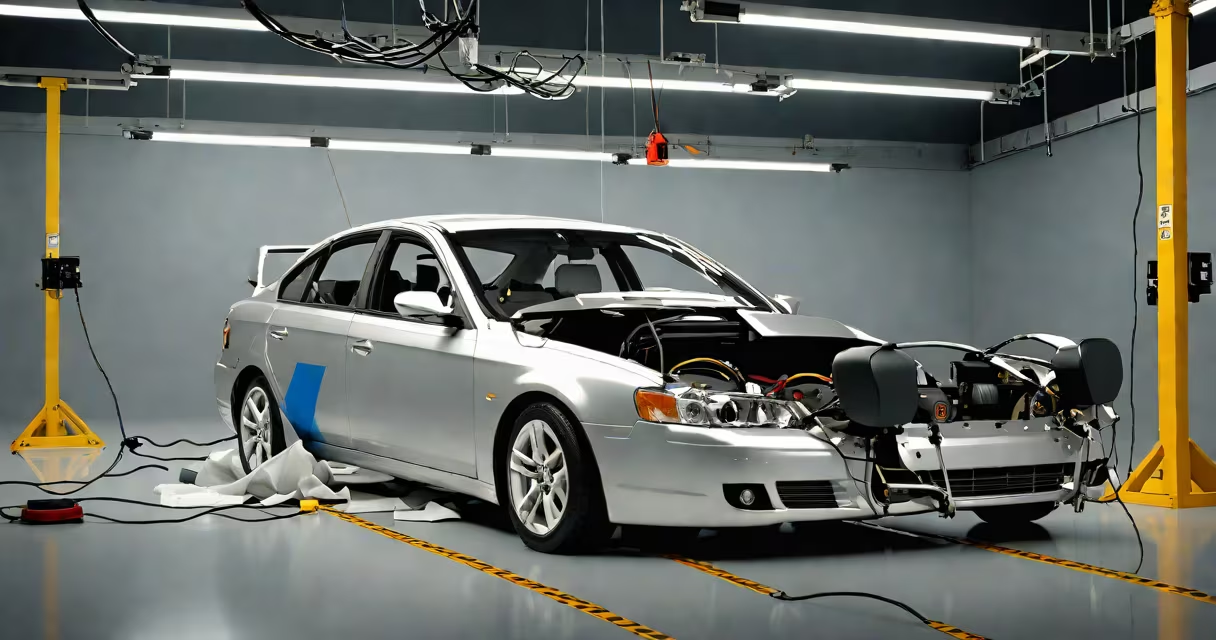
The insurance institute for highway safety (IIHS) is a nonprofit organization that conducts independent crash tests and safety evaluations of vehicles to reduce injuries and fatalities in traffic accidents. It operates under the auspices of the Insurance Information Institute and uses real-world crash scenarios to assess how well vehicles protect occupants.
Founded in 1959 as the Highway Loss Data Institute, the IIHS evolved into its current form in 1995 after merging with other safety-focused groups. Its mission centers on reducing harm from crashes through evidence-based research and public reporting. The organization's findings directly inform auto insurers' risk assessments and influence vehicle design standards globally.
IIHS conducts five primary crash tests: small overlap front, moderate overlap front, side impact, roof strength, and headlight performance. These tests simulate common accident types and measure both structural integrity and occupant protection. Vehicles earn ratings ranging from Good to Poor based on results, with the highest scores indicating superior safety performance.
How IIHS Testing Works
Each test begins with a controlled collision at speeds between 35 mph and 40 mph, depending on the scenario. For example, the small overlap front test involves striking the front corner of a vehicle at 40 mph, simulating a collision with a tree or utility pole. This test is particularly challenging because it bypasses the main crumple zones, forcing the structure to absorb energy through less protected areas.
During testing, sensors record deceleration forces, intrusion levels, and movement of the dummy's head and neck. High-speed cameras capture deformation patterns. Afterward, engineers analyze data to determine whether the vehicle met safety thresholds. A score of "Good" requires minimal intrusion, proper airbag deployment, and low injury risk metrics.
For example, in 2022, the Toyota Corolla received a "Good" rating in all IIHS categories despite being a compact sedan. This outcome was due to its reinforced cabin structure and effective seatbelt pretensioners, which limited head movement during side impacts. The model scored above average in both small and moderate overlap tests, demonstrating that even entry-level vehicles can achieve high safety marks with proper engineering.
Types of IIHS Ratings and What They Mean
The IIHS assigns a single rating-"Top Safety Pick" or "Top Safety Pick+"-based on performance across multiple tests. To qualify for Top Safety Pick+, a vehicle must earn "Good" ratings in all six core tests: small overlap front, moderate overlap front, side impact, roof strength, headlight performance, and seat/shoulder belt effectiveness.
| Test Type | Impact Speed | Key Focus Area | Rating Threshold |
|---|---|---|---|
| Small Overlap Front | 40 mph | Cabin integrity, steering column deformation | Good (minimal intrusion) |
| Moderate Overlap Front | 40 mph | Crash energy absorption, airbag deployment timing | Good (low injury risk) |
| Side Impact | 31 mph | Door and B-pillar strength, dummy head movement | Good (head contact ≤ 10 mm) |
| Road Test | Static load | Roof strength relative to vehicle weight | At least 4 times the vehicle's weight |
| Headlights | Real-world driving conditions | Beam pattern, glare reduction | Good or Acceptable |
One non-obvious distinction: the IIHS does not rate rear-end collisions or pedestrian protection in its standard evaluation. While some manufacturers voluntarily submit vehicles for additional testing, these are not part of the official safety pick program. This focus on occupant protection during frontal and side impacts reflects the institute's prioritization of survivability in high-energy crashes.
Where and Why IIHS Ratings Matter
Car buyers rely heavily on IIHS ratings when choosing new models. According to a 2023 study by the National Highway Traffic Safety Administration (NHTSA), vehicles earning Top Safety Pick status had 24% lower fatality rates in crashes compared to those without the designation. This correlation underscores the practical impact of IIHS testing beyond marketing claims.
Automakers adjust designs specifically to meet IIHS criteria. For instance, Volvo redesigned its XC60's B-pillar and door beams after early prototypes failed the side impact test. The revised version passed with a "Good" rating, leading to increased sales and improved insurer loss ratios. The company credits the IIHS as a key driver in advancing structural safety standards.
Insurance companies use IIHS data to set premiums. Vehicles rated "Good" in crash tests typically receive lower liability and collision coverage costs. For example, a 2021 analysis by the Insurance Information Institute showed that drivers of Top Safety Pick+ vehicles paid 12% less on average for complete coverage than those with vehicles rated "Poor." This direct financial link reinforces the value of objective safety testing.
Common Misconceptions and Clarifications
Many assume that NHTSA crash ratings and IIHS ratings are interchangeable. They are not. NHTSA uses a five-star system based on a single frontal crash at 35 mph and a side impact at 31 mph. The IIHS goes further, testing smaller overlaps and evaluating lighting systems-factors NHTSA does not include in its scoring.
Another misconception is that all vehicles tested by IIHS are luxury models. In reality, the institute tests a broad spectrum of vehicles, including economy cars like the Honda Fit and budget SUVs such as the Kia Seltos. In 2023, the Hyundai Tucson earned a Top Safety Pick+ despite being priced below $30,000, proving that affordability and safety are not mutually exclusive.
I once observed an IIHS test live at their facility in Arlington, Virginia. During a small overlap front test, a compact crossover collapsed at the front left corner. The dummy's head struck the interior panel, triggering a warning light. The vehicle was later classified as "Poor" in that category-a rare outcome for a modern model. That moment highlighted how the IIHS identifies risks that may go unnoticed in standard regulatory testing.