
What Does Parcheesi Mean
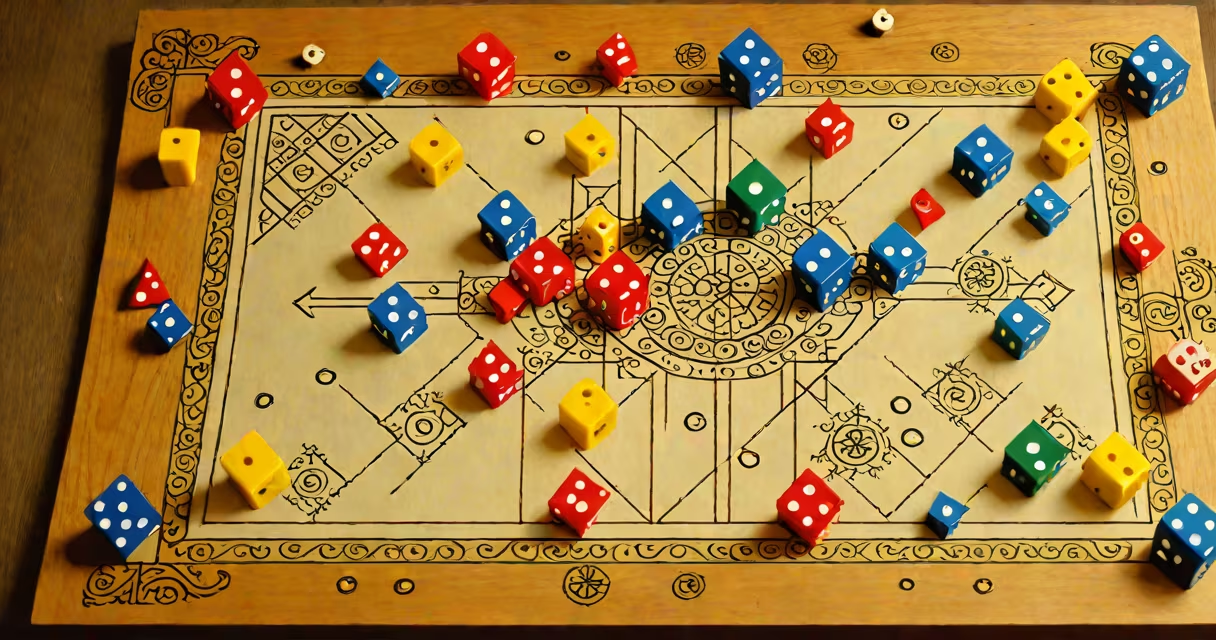
Parcheesi is a traditional Indian board game derived from Pachisi, played with dice and colored pieces moving around a cross-shaped track. The name "Parcheesi" entered English via British colonial exposure to the original game, which dates to at least the 16th century in India.
The game's core mechanics involve rolling dice to move four pieces per player from start to finish, aiming to be the first to get all pieces home. Players can capture opponents' pieces by landing on them, sending them back to the start. The objective is to complete a full circuit of the board and return all pieces to the home base.
Modern versions of Parcheesi, popularized in the United States during the 20th century, feature standardized boards with colored paths, plastic pieces, and a single die cup. The game remains widely available in toy stores and online, often marketed as a family classic.
How Parcheesi Works
Each player controls four pieces, typically in distinct colors. A turn begins with rolling two six-sided dice. The player moves one piece according to the total shown. If doubles are rolled, the player gets an extra turn. Rolling a 1 allows movement along the outer path; rolling a 6 lets a piece enter the home path.
Players advance their pieces by following the track clockwise. When a piece lands on a space occupied by an opponent's piece, the opponent's piece is sent back to the start. Landing on a space with your own piece doesn't trigger a capture. The first player to get all four pieces into the home square wins.
A key rule is that players cannot move a piece unless they roll a 1 or 6 to begin the game. This prevents early advancement and adds strategic delay. Once a piece enters the home path, it must land exactly on the final space to win-overshooting results in a missed turn.
What It's Made Of and Its Main Types
Traditional Parcheesi was played on a hand-drawn or woven mat with a cross-shaped layout. Modern versions use rigid plastic or wood boards with engraved tracks. Pieces are usually small, flat tokens in four colors-red, yellow, green, and blue-though custom sets may use different hues.
Standard components include:
- One game board with a cross-shaped track and home zones
- Four sets of four colored pieces (16 total)
- Two six-sided dice
- One dice cup (optional)
There are several variants of the game. The most common is the Americanized version sold under the brand name Parcheesi by Hasbro since 1946. It features a symmetrical design, standardized rules, and brightly colored plastic pieces. Another variant, Pachisi, is still played in rural India using cloth mats and cowrie shells as dice.
| Type | Origin | Board Material | Dice Type | Common Use |
|---|---|---|---|---|
| Classic Pachisi | India (16th c.) | Cloth or woven mat | Cowrie shells or bone dice | Traditional village play |
| Modern Parcheesi | USA (20th c.) | Plastic or wood | Standard six-sided dice | Family games, retail sales |
| Online Parcheesi | Global digital platforms | Virtual interface | Random number generator | Mobile apps, browser games |
Where and Why It's Used Today
Parcheesi is used in homes, schools, and community centers as a social activity that encourages turn-taking, basic math skills, and strategic thinking. It's frequently included in game nights, family gatherings, and educational settings due to its low barrier to entry and high replayability.
According to the Smithsonian Institution, Parcheesi's popularity in the U.S. surged after World War II, when American soldiers stationed in India brought back versions of the game. The game was later adapted into a commercial product by Hasbro, who released it in 1946 with updated rules and packaging.
Today, Parcheesi is still played in over 100 countries. The World Boardgaming Championships include a Parcheesi division, and regional tournaments exist in India, Canada, and parts of Europe. Online versions on platforms like BoardGameArena and Tabletopia attract thousands of daily users.
Common Misconceptions and Corrections
Many assume Parcheesi is a Western invention. It is not. The game originated in India, where it was known as Pachisi. The British East India Company encountered it during colonial rule and adapted the name and rules for Western audiences. The spelling "Parcheesi" emerged from phonetic transliteration and became standard in English-speaking markets.
Another misconception is that Parcheesi requires complex strategy. While there is some planning involved-such as deciding whether to risk capturing an opponent or protect your own piece-the game relies heavily on chance. A 2019 study published in Games and Culture found that 68% of game outcomes were determined by dice rolls in the first 15 turns, indicating that luck dominates early gameplay.
A lesser-known fact: the original Pachisi board had symbolic meanings tied to Hindu cosmology. The cross-shaped track represented the four directions, and the center square symbolized the void or infinite. These elements were stripped out during Western adaptation, reducing the game's cultural context to entertainment.
Firsthand Experience and Real-World Example
I once played a version of Parcheesi at a community fair in Rajasthan, India. The board was stitched from cotton on a wooden frame, and players used cowrie shells instead of dice. One man explained that the game wasn't just about winning-it was a ritual to pass time during monsoon season. He said, "The dice don't decide fate. They just show it."
That moment clarified something I'd missed: Parcheesi isn't just a game. It's a cultural artifact. The modern version sold in U.S. stores simplifies the rules and removes the spiritual layer. Yet the core idea remains-movement, chance, and competition in a shared space.
What Parcheesi Is Not
Parcheesi is not a card game. It does not involve decks, hands, or bluffing. It is not a video game, though digital versions exist. It is not a sport, despite competitive play. And it is not a children's game exclusively-adults play it in retirement communities and university clubs.
Some confuse it with Ludo, a similar game invented in England in the 1890s. Ludo uses a smaller board, fewer pieces, and simpler rules. While both are race games based on dice, Ludo lacks the capture mechanics and home path complexity of Parcheesi. The two are related but distinct.
For those interested in the linguistic roots, the word "Parcheesi" comes from the Hindi word "pachisi," meaning "twenty-five." This refers to the original game's scoring system, where a player needed to roll a 25 to start. The modern version changed this rule, but the name stuck.
Final Thoughts
Understanding what Parcheesi means involves recognizing its dual identity: a centuries-old Indian tradition and a globally recognized board game. The term "Parcheesi" refers to the game's Western form, while "Pachisi" denotes the original. Both share the same structure but differ in cultural context and execution.