
Time Zone Illinois
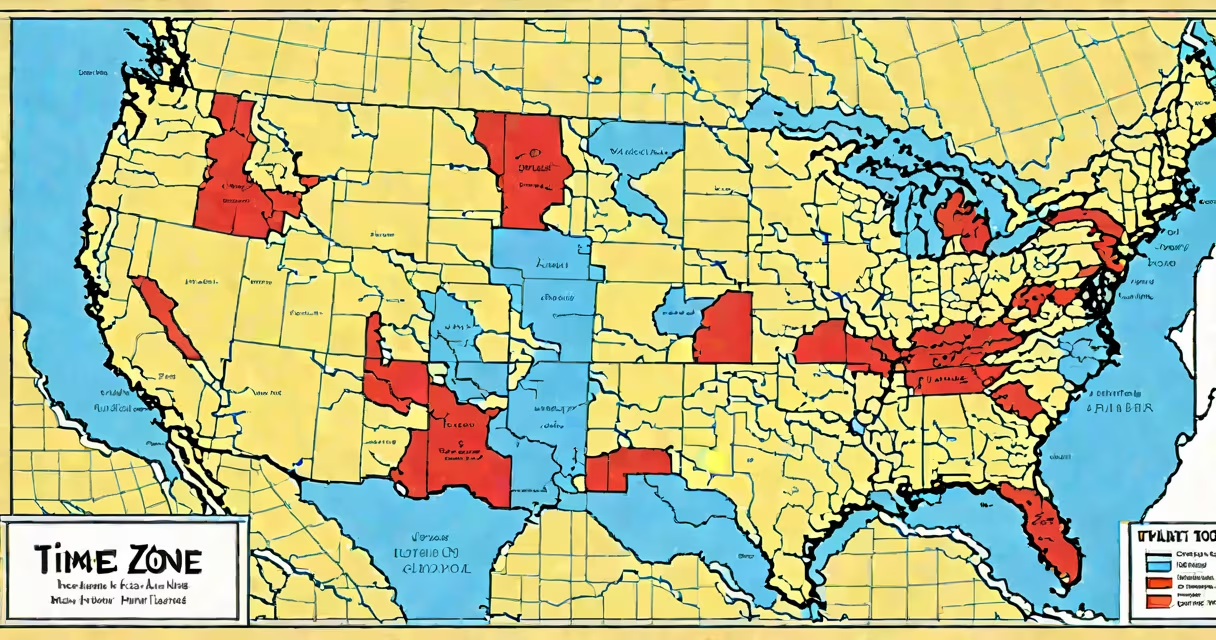
Illinois uses two time zones: Central Time Zone (UTC−6) during standard time and Eastern Time Zone (UTC−5) in the far eastern counties during standard time. During daylight saving time, most of the state shifts to Central Daylight Time (UTC−5), while the easternmost counties remain on Eastern Daylight Time (UTC−4).
Illinois lies entirely within the United States' Central and Eastern time zones. The dividing line runs roughly along the Indiana border, west of Lake Michigan. Counties such as Cook (home to Chicago), DuPage, and Will follow Central Time. Counties like Alexander, Union, and parts of Jackson and Massac observe Eastern Time.
Daylight saving time begins on the second Sunday in March and ends on the first Sunday in November. During this period, clocks move forward one hour. This means that in spring, Illinois residents in Central Time see their clocks go from 1:59 AM to 3:00 AM, skipping 2:00-2:59 AM. The same happens in reverse when daylight saving ends.
How Time Zones Are Determined in Illinois
The U.S. Department of Transportation sets official time zone boundaries based on geographic and administrative lines. Illinois's division stems from historical railroad routing decisions in the late 1800s. Before standardized time zones, each town set its own clock based on local solar noon. The railroads needed consistent scheduling, leading to the adoption of four national time zones in 1883.
Illinois was split between the Central and Eastern zones because of its proximity to major cities and transportation routes. Chicago, as a central hub, adopted Central Time. The eastern portion, near the Ohio River and close to St. Louis and southern Indiana, aligned with Eastern Time due to economic ties and regional coordination.
Local governments cannot override federal time zone designations. Even though some communities in the eastern part of the state have discussed switching to Central Time to reduce confusion, no changes have passed since 1966. The Uniform Time Act of 1966 established daylight saving time nationwide and assigned states to specific zones.
Types of Time Used in Illinois
Illinois observes two primary time zones, each with standard and daylight saving variants:
| Region | Standard Time | Daylight Saving Time |
|---|---|---|
| Central Illinois (e.g., Chicago) | Central Standard Time (CST), UTC−6 | Central Daylight Time (CDT), UTC−5 |
| Eastern Illinois (e.g., Cairo, Marion) | Eastern Standard Time (EST), UTC−5 | Eastern Daylight Time (EDT), UTC−4 |
When daylight saving time is active, Central Illinois runs one hour behind Eastern Illinois. For example, when it is 12:00 PM in Chicago, it is 1:00 PM in Cairo. This difference persists until daylight saving ends in November.
A common mistake is assuming all of Illinois follows Central Time. The state's eastern counties are in the Eastern Time Zone year-round, except during daylight saving, when they shift to EDT. This creates a one-hour gap between the two regions during summer months.
Why People Confuse Time Zones in Illinois
Confusion often arises because Illinois shares borders with multiple states using different time zones. Indiana, for example, has both Central and Eastern Time zones. When crossing from Illinois into southern Indiana, travelers may notice clocks jump forward or backward depending on the county.
Another misconception is that daylight saving time applies uniformly across the state. While most of Illinois observes the same start and end dates, the time difference between Central and Eastern zones remains constant throughout the year. A meeting scheduled at 9:00 AM Central Time in Chicago will be at 10:00 AM in Cairo during daylight saving.
Even accurate digital clocks can mislead. Smartphones and computers sync to network time servers based on location settings. If a device is set to Central Time but the user is in eastern Illinois, the displayed time will be off by one hour unless manually corrected.
Real-World Example: Scheduling Across Illinois
Consider a school district with campuses in both Chicago and Cairo. A video conference scheduled at 3:00 PM Central Time (CDT) begins at 4:00 PM Eastern Time (EDT). Teachers in Chicago see 3:00 PM, while those in Cairo see 4:00 PM. Without clear labeling, participants may join at the wrong time.
Businesses coordinating across the state must account for this. A company in Rockford (Central Time) sending a report to a partner in Carbondale (Eastern Time) must specify whether the deadline is 5:00 PM CST or 5:00 PM EST. Using "5:00 PM" alone introduces ambiguity.
During daylight saving transitions, errors compound. In March, when clocks move forward, people in eastern Illinois gain an extra hour of sleep compared to those in the west. In November, when clocks fall back, the entire state experiences a one-hour overlap in the night.
Common Misconceptions and Corrections
Some believe Illinois observes only Central Time. This is false. The state includes areas in both Central and Eastern Time zones. According to the National Institute of Standards and Technology (NIST), 48 of Illinois's 102 counties are in the Central Time Zone, and 54 are in the Eastern Time Zone.
Another myth is that daylight saving time is optional. The Uniform Time Act mandates uniform observance across states. Illinois does not allow individual counties to opt out. All counties follow the same start and end dates for daylight saving.
Finally, some assume that time zones are purely geographic. They are not. Time zone boundaries reflect political and economic decisions. The boundary between Central and Eastern Illinois was drawn in 1883 by the General Time Convention, which grouped rail lines and urban centers into zones.
Personal Experience: Coordinating a Statewide Event
I once organized a public health webinar involving teams from Chicago, Springfield, and Cairo. We set the event for 1:00 PM Central Time. On the day, three team members joined late-two from Cairo and one from Chicago. The Cairo team thought the time was 1:00 PM Eastern Time, not realizing the event was scheduled in Central Time. After adjusting, we added explicit time zone labels: "1:00 PM CST (2:00 PM EST)" in all communications.
This error highlighted how easily time zone differences cause missed connections. Since then, I've always include both time zones when scheduling across Illinois.
Resources and Tools
Understanding time zone Illinois prevents scheduling errors, improves communication, and ensures accuracy in travel, business, and emergency response. Always verify the time zone of your location and the recipient's when setting appointments.