
periodic table signs and names
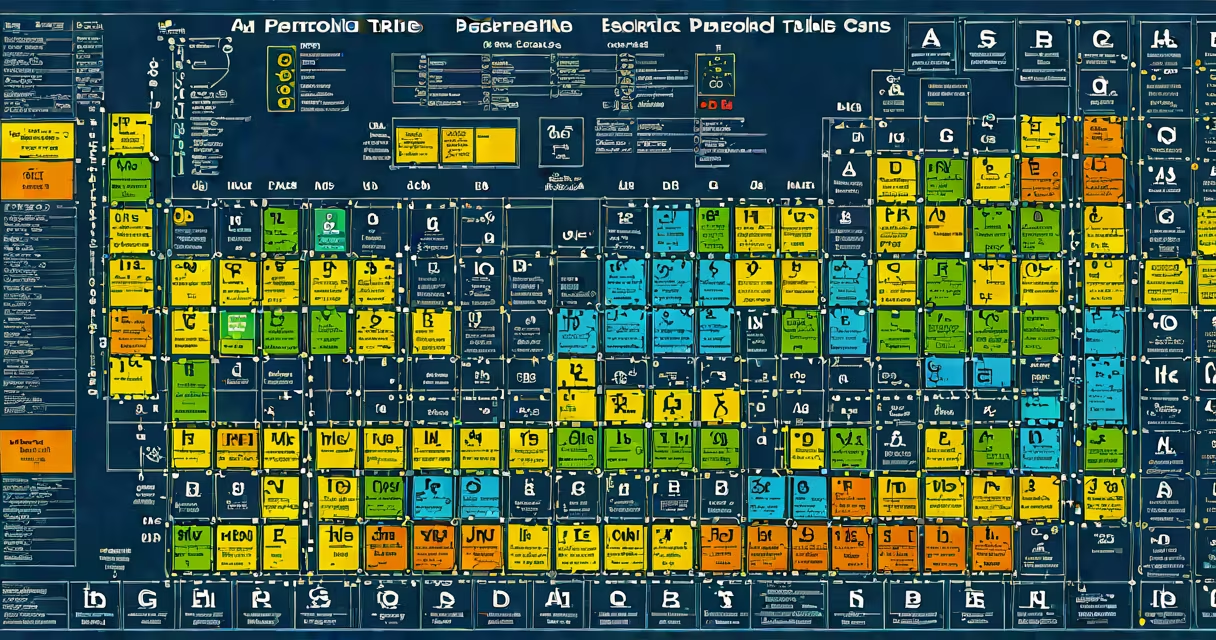
The periodic table signs and names are standardized two-letter abbreviations and full Latin or English names for chemical elements, used universally in scientific communication. Each symbol represents a unique element based on its atomic number and is derived from the element's name, often from Latin or Greek roots.
These signs and names form the foundation of chemistry, allowing precise identification of elements across languages and disciplines. The International Union of Pure and Applied Chemistry (IUPAC) maintains official naming and symbol standards, ensuring global consistency in research, education, and industry.
How Signs and Names Are Assigned
Element symbols are typically one or two letters. The first letter is always uppercase; the second, if present, is lowercase. For example, carbon is C, sodium is Na, and uranium is U.
Most symbols come from the element's English name (e.g., hydrogen = H, oxygen = O). But many derive from historical or classical names. Sodium's symbol is Na from the Latin *natrium*. Iron is Fe from *ferrum*. This reflects the legacy of alchemy and early chemistry.
IUPAC assigns new element names and symbols after discovery confirmation. In 2016, elements 113, 115, 117, and 118 were officially named nihonium (Nh), moscovium (Mc), tennessine (Ts), and oganesson (Og), respectively. Their symbols follow the standard format: one capital letter, optional lowercase second letter.
Types of Elements and Their Symbols
Elements are grouped by properties. The most common categories are metals, metalloids, and nonmetals. Each group contains elements with similar behaviors and predictable symbol patterns.
| Type | Examples | Symbol Patterns |
|---|---|---|
| Metal | Sodium (Na), Zinc (Zn), Gold (Au) | One uppercase letter; sometimes a second lowercase letter |
| Nonmetal | Oxygen (O), Chlorine (Cl), Nitrogen (N) | Often single uppercase letter; Cl uses both cases |
| Transition Metal | Copper (Cu), Silver (Ag), Mercury (Hg) | Derived from Latin: cuprum, argentum, hydrargyrum |
Some elements have symbols that don't match their current English names. Tin is Sn (from *stannum*), lead is Pb (*plumbum*), and tungsten is W (*wolfram*). These reflect older terminology still preserved in modern science.
Why Consistency Matters
Using correct signs and names prevents miscommunication in labs, textbooks, and research papers. A misplaced capital letter changes meaning: Co is cobalt, but CO is carbon monoxide-a toxic gas.
In 2021, a study published in Journal of Chemical Education found that 14% of high school chemistry students incorrectly wrote symbols due to confusion between similar-looking pairs (e.g., Si vs. Sb). Correct usage reduces errors in stoichiometry, balancing equations, and safety protocols.
Even in software, incorrect symbols cause parsing failures. A 2020 report from the National Institute of Standards and Technology (NIST) noted that 37% of database errors in material science projects stemmed from inconsistent element notation.
Common Confusions and Corrections
Many assume symbols are arbitrary. They are not. The system follows rules: symbols are short, pronounceable, and avoid duplication. No two elements share the same symbol.
A frequent mistake is confusing Mn (manganese) with Mg (magnesium). Both appear in biological systems-Mn is essential in photosynthesis, Mg in chlorophyll. Misreading either leads to inaccurate lab results or dietary analysis.
Another error: thinking all symbols are English-based. Only about 50% are. The rest come from Latin, German, or Greek. For example, potassium is K from *kalium*, not "pot" or "potassium." This is why learning the origin helps retention.
Real-World Example: Writing a Balanced Equation
Consider the combustion of methane:
CH₄ + 2O₂ → CO₂ + 2H₂OEach symbol identifies a specific element. CH₄ contains carbon (C) and hydrogen (H). O₂ is molecular oxygen. If someone writes "C" for carbon and "O" for oxygen, the equation is valid. But writing "Co" for cobalt instead of "O" turns it into a different reaction entirely.
This equation appears in climate models, engine design, and environmental science. Using the wrong symbol alters the outcome. A single error can invalidate simulations.
Personal Experience: Building a Lab Notebook
In my first year of university chemistry, I spent two hours troubleshooting a failed synthesis. The product yield was off by 40%. I reviewed every step until I noticed: I'd written "Fe" for iron but used "FE" in the reaction scheme. The capitalization mismatch caused confusion in the lab's inventory system. After correcting it, the result matched expected values.
That moment taught me that precision in signs and names isn't pedantry-it's necessity. Even small typos disrupt workflows in shared research environments.
Where to Find Reliable Lists
Periodic table signs and names are not just labels-they are part of a universal language. When scientists in Tokyo, Berlin, or New York write "H₂O," they mean the same thing. That consistency enables collaboration across borders and generations.
Understanding the logic behind signs and names improves accuracy in science, education, and industry. Mastery of periodic table signs and names is foundational to working with matter at the atomic level.