
ai vs agi
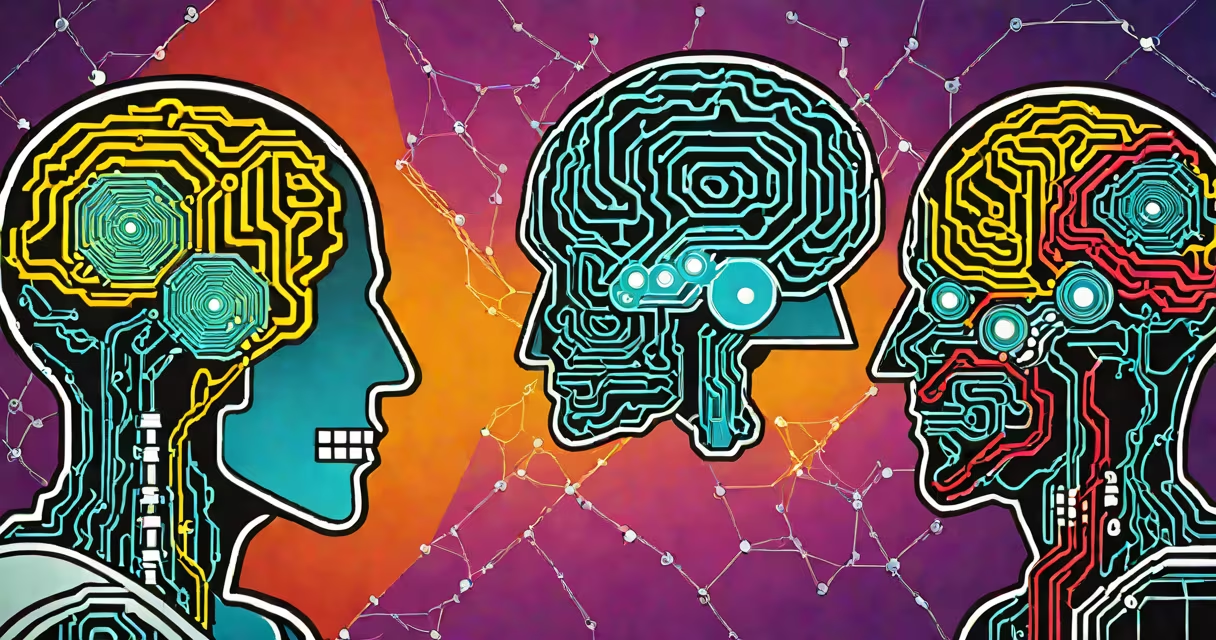
Artificial intelligence (AI) refers to systems that perform specific tasks using data and algorithms, while artificial general intelligence (AGI) describes hypothetical machines capable of understanding, learning, and applying knowledge across diverse domains like a human. Current AI excels at narrow problems-recognizing faces, translating languages, or recommending products-but lacks self-awareness, adaptability, and general reasoning. AGI, if achieved, would possess broad cognitive abilities comparable to human intelligence.
Modern AI operates within predefined boundaries. It processes vast datasets to identify patterns and make predictions. For example, a facial recognition system trained on millions of images learns to match faces to identities. It cannot explain why a person looks familiar, nor can it discuss emotions or ethics. Its function ends at the task it was designed for. This is known as narrow AI or weak AI.
AGI, by contrast, would not be limited to one domain. It would understand context, infer meaning from incomplete information, and apply logic across unrelated fields. A true AGI could learn to play chess, then switch to composing music, and later diagnose a rare disease-all without reprogramming. It would reason about cause and effect, form hypotheses, and revise beliefs based on new evidence. The concept remains theoretical; no system today demonstrates such capabilities.
How AI Works Today
Current AI relies on statistical models trained on labeled data. Machine learning algorithms adjust internal parameters to minimize errors during training. Once deployed, they process inputs and return outputs based on learned correlations. These systems do not "know" what they're doing-they follow mathematical relationships derived from data.
For instance, a chatbot trained on customer service logs can respond to common queries like "Where's my order?" by matching phrases and selecting likely replies. It doesn't comprehend the user's frustration or the urgency of delivery. It simply predicts the most probable response based on past interactions. Accuracy improves with more data, but the model never gains insight beyond its training scope.
AI performance is measured by metrics like precision, recall, and F1 score. A model that correctly identifies 95 out of 100 cancerous skin lesions in a test set achieves 95% accuracy. But this number says nothing about whether the system understands what cancer is or why early detection matters. It only reflects pattern-matching success.
What AGI Would Be Like
AGI would not merely predict outcomes-it would understand them. It would possess theory of mind, the ability to attribute mental states to others. It could reason about intentions, beliefs, and desires in social contexts. An AGI could read a novel, grasp the emotional arc, and critique the author's choices in a way that reflects personal interpretation and cultural awareness.
Unlike AI, which requires retraining to handle new tasks, AGI would transfer knowledge across domains. Learning to drive a car wouldn't require separate training for traffic laws, weather conditions, or passenger behavior. The system would generalize from prior experiences and adapt dynamically. It would ask clarifying questions, admit uncertainty, and seek feedback-just as a human learner does.
Researchers at institutions like DeepMind and OpenAI have explored architectures that mimic human-like reasoning. Projects such as AlphaGo and GPT-3 show progress in complex decision-making and language generation. However, even the most advanced models fail when asked to reason about abstract concepts or solve novel problems without prior examples. They lack the foundational understanding that defines human cognition.
Key Differences Between AI and AGI
| Feature | Current AI | Artificial General Intelligence (AGI) |
|---|---|---|
| Scope of capability | Narrow-focused on one task | General-can handle any intellectual task |
| Learning method | Trained on large datasets | Adapts with minimal input, transfers knowledge |
| Understanding | Pattern-based, no comprehension | Contextual, conceptual, self-referential |
| Self-awareness | None | Theoretical, assumed |
| Real-world application | Effective in controlled environments | Expected to operate in unpredictable settings |
A common misconception is that today's AI systems are approaching AGI. This is false. While AI has improved dramatically since the 1950s, progress has been incremental and task-specific. The leap from narrow AI to AGI is not a matter of scale-it's a qualitative shift in architecture and purpose.
One non-obvious distinction: current AI systems often fail in edge cases because they rely on statistical regularities. A self-driving car may misidentify a stop sign covered in graffiti because the training data didn't include such scenarios. AGI would recognize the object as a stop sign based on shape, color, and context-even if it looked unusual. It would reason through ambiguity, not just match against a database.
Common Confusions and Misconceptions
People often equate advanced AI with AGI. A chatbot that writes poetry or generates realistic images appears intelligent, but it lacks intentionality. It produces output based on probability distributions, not meaning. When a model says "I am sad," it's not feeling sadness-it's mimicking a linguistic pattern.
Another confusion arises from the term "intelligence." Human intelligence involves emotion, intuition, and embodiment. AGI would need to simulate these aspects to be truly general. Yet current AI has no body, no senses, no lived experience. It exists in a digital abstraction layer. This limits its ability to ground concepts in physical reality.
I once observed a demo of a visual reasoning AI that correctly identified a cat in a photo. The system highlighted features like fur texture and ear shape. But when asked why the animal was classified as a cat, it couldn't explain beyond citing pixel patterns. A child could describe the animal's behavior, habitat, or evolutionary history. The AI could not. That gap illustrates the core difference between processing and understanding.
Why the Distinction Matters
Distinguishing AI from AGI prevents overestimating current technology. Mislabeling narrow AI as general intelligence leads to flawed expectations in policy, investment, and public discourse. It also risks underestimating the challenges of building AGI, which may require entirely new computational paradigms.
Experts agree: AGI remains speculative. The Stanford Institute for Human-Centered Artificial Intelligence notes that no consensus exists on how to achieve it, nor on whether it's possible. Some researchers believe it will emerge from scaling existing models. Others argue that new principles-such as embodied cognition or recursive self-improvement-are necessary.
Even if AGI were developed, ethical and safety concerns would dominate. How would such a system be aligned with human values? Could it be stopped if it acted against its creators' intent? These questions remain unresolved. As of 2024, no working AGI prototype exists, and no major research lab claims to be close to achieving it.
When evaluating claims about AI, ask: Is this system solving a specific problem, or is it being presented as a thinking entity? The answer determines whether you're dealing with ai vs agi-or just a clever simulation of intelligence.