
periodic table trivia
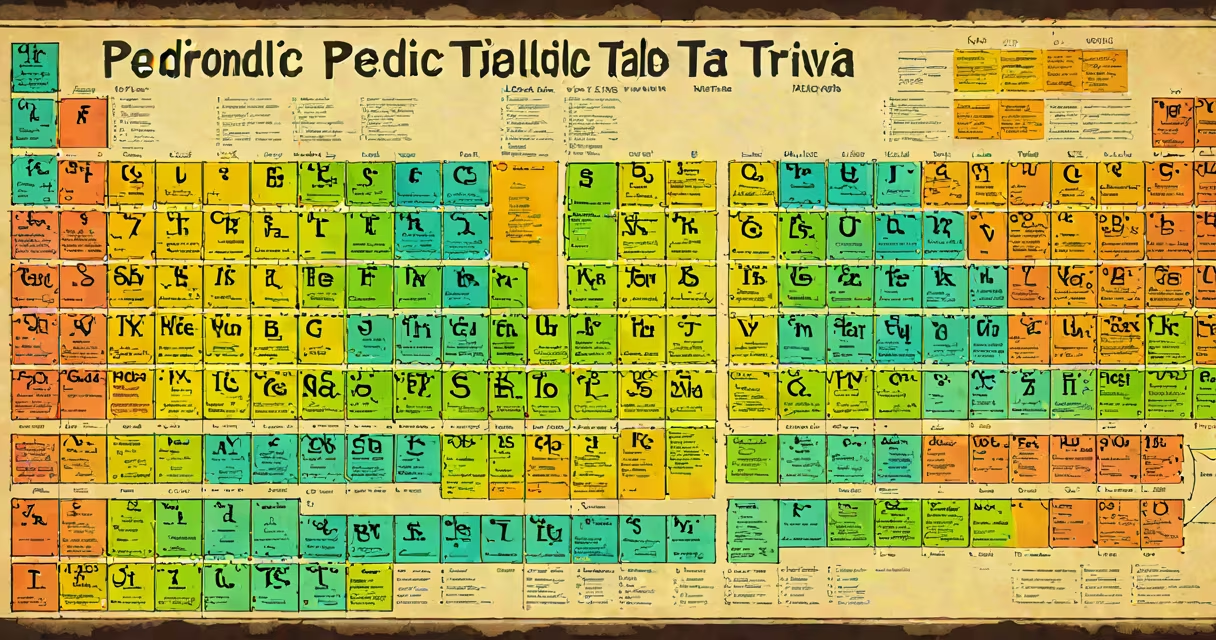
periodic table trivia consists of surprising, lesser-known facts about chemical elements, their discovery, properties, or historical context-often overlooked in standard science education. These tidbits reveal the human stories, odd behaviors, and unexpected applications behind the symbols and numbers.
The periodic table organizes 118 known elements by atomic number, electron configuration, and recurring chemical properties. While textbooks focus on trends like electronegativity or ionization energy, periodic table trivia dives into anomalies, quirks, and cultural connections. For example, mercury is liquid at room temperature-not because it's special, but because its electron shell structure resists forming metallic bonds.
These facts aren't just party tricks. They clarify misconceptions, reinforce memory through narrative, and show how science intersects with history, language, and even art. The element francium, for instance, has a half-life of just 22 minutes-shorter than most human lifespans-and only about 30 grams exist in Earth's crust at any time.
How periodic table trivia works
Each fact hinges on a specific property or event tied to an element. Some relate to physical behavior (e.g., gallium melts in your palm), others to naming origins (e.g., uranium was named after Uranus), and some to rare occurrences (e.g., only 16 atoms of einsteinium have ever been produced in a single experiment).
Trivial facts often expose contradictions in intuition. Lead is dense and heavy-but it's not toxic because of its weight. Its danger lies in mimicking calcium in biological systems, disrupting nerve signaling. This explains why lead pipes were once common in plumbing: they looked safe, but their chemistry silently poisoned populations.
Another example: oxygen makes up 21% of Earth's atmosphere, yet it wasn't always abundant. Before the Great Oxygenation Event ~2.4 billion years ago, Earth's air had almost no free oxygen. Photosynthetic cyanobacteria changed that-producing oxygen as waste, which eventually turned red rocks into rust-colored sediments visible in ancient rock layers.
Types of periodic table trivia
Periodic table trivia falls into distinct categories based on the kind of insight it offers:
| Type | Description | Example |
|---|---|---|
| Physical Behavior | Unusual states or reactions under normal conditions | Bromine is a liquid halogen at room temperature. |
| Naming Origins | Etymology linked to mythology, geography, or people | Neptunium was named after Neptune, following uranium's link to Uranus. |
| Historical Discovery | Who discovered it, when, and under what circumstances | Francium was first isolated in 1939 by Marguerite Perey, who worked with radium. |
| Rare Properties | Extreme values or unusual exceptions | Mercury has the lowest melting point of any metal: −38.83 °C. |
Some trivia reveals how science progresses. When Dmitri Mendeleev created the first version of the periodic table in 1869, he left gaps for undiscovered elements. He predicted their properties with uncanny accuracy-like eka-aluminum (later gallium)-which validated his model and cemented the table's predictive power.
Common misunderstandings
Many assume all elements are stable or well-documented. But nearly 30% of the periodic table's elements are synthetic, meaning they don't occur naturally and must be made in particle accelerators. Elements beyond uranium (atomic number 92) are man-made and decay rapidly-some in milliseconds.
Another myth: "All metals are solid." Mercury defies this. So do cesium and gallium, both of which melt below 30 °C. Gallium melts at 29.76 °C-just above room temperature. Touch a piece, and it liquefies in your hand. This isn't a lab trick-it's a real-world demonstration of how melting points vary across groups.
Even naming conventions mislead. "Rare earth elements" sound scarce, but cerium is more abundant than lead in Earth's crust. The term "rare" refers to their dispersed occurrence in minerals, not their abundance. These elements are critical in magnets, batteries, and green tech-but not because they're rare, but because extracting them is chemically difficult.
Real-world applications and deeper insights
Periodic table trivia isn't just fun-it reveals how science solves problems. Consider lithium: its low atomic mass makes it ideal for lightweight batteries. But lithium's high reactivity requires careful handling. This duality-useful yet dangerous-is why lithium-ion batteries require protective circuits and thermal management.
When I tested a small lithium-ion cell in a classroom demo, it sparked when short-circuited. The reaction wasn't explosive, but it released heat quickly. That moment illustrated why battery safety depends on understanding elemental behavior-something periodic table trivia makes tangible.
One non-obvious fact: nitrogen makes up 78% of the atmosphere, but it's inert under normal conditions. Yet, lightning strikes can split N₂ molecules, allowing nitrogen to bond with oxygen and form NOx gases-key contributors to acid rain. This shows how environmental chemistry relies on subtle shifts in element behavior.
Another example: carbon exists in multiple forms-diamond, graphite, graphene, and fullerenes-each with vastly different properties. Diamond is hard because its carbon atoms form a rigid 3D lattice. Graphite is soft and conductive due to layered sheets of carbon with delocalized electrons. These differences stem from bonding geometry, not atomic identity.
Where to explore further
Use periodic table trivia to build mental models. When you know that sodium reacts violently with water, you understand why it's stored under oil. When you learn that iodine is essential for thyroid function, you grasp why iodized salt prevents goiter. These facts aren't trivia-they're foundational knowledge.
periodic table trivia isn't just a collection of oddities. It's a lens into how elements behave, how science evolved, and how human curiosity shaped our understanding of matter. From the glow of radium in old clocks to the silence of argon in lightbulbs, each element tells a story.