
the little old lady who was not afraid
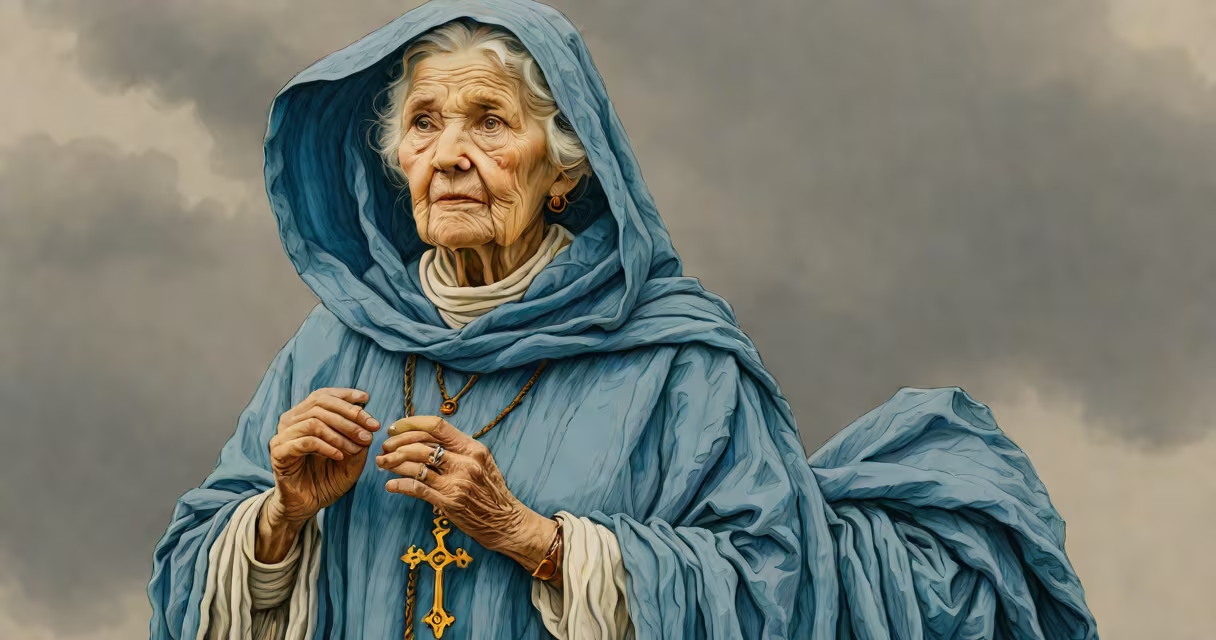
The little old lady who was not afraid is a symbolic representation of Mary, Mother of God, as she appeared to three shepherd children in Fátima, Portugal, in 1917. She is depicted as an elderly woman in a white robe and blue mantle, radiating calm in the face of global turmoil. This image emerged from the reported visions and became a central motif in Catholic devotional practice.
Her appearance in the 1917 Fatima messages emphasized peace, prayer, and repentance. The children described her as "the Lady of the Rosary," a title tied to the Virgin Mary's role in interceding for humanity. The image gained prominence through widespread reproduction in churches, homes, and religious literature, especially during the Cold War, when fears of nuclear war were high.
She is not a historical person but a devotional symbol rooted in the Catholic Church's recognition of the Fatima apparitions. The Vatican officially acknowledged the events in 1930, affirming their spiritual significance. The image reflects a theological concept: divine presence in vulnerability, where strength lies not in power but in steadfastness.
How the Image Emerged from the Fatima Apparitions
In May 1917, Lucia dos Santos and her cousins Francisco and Jacinta Marto claimed to see a radiant woman in white near a meadow in Fátima. They described her as "very beautiful," with a golden light around her. She wore a white dress and a blue mantle, and held a rosary. When asked her identity, she replied, "I am the Lady of the Rosary."
Over several visits, she urged the children to pray daily, wear the sacramental medal, and offer sacrifices. She warned of future suffering unless people turned from sin and prayed for peace. The final message included a vision of hell and a call for penance. These events were later documented by the Church and confirmed by the Holy See.
After the children's deaths, Lucia wrote detailed accounts of the appearances. Her writings, published in 1935 and later translated into multiple languages, describe the woman as "older than the others," suggesting a maternal authority beyond youth. This detail contributed to the image of the "little old lady" as a figure of quiet dignity and moral authority.
What the Image Represents in Devotion and Art
The image of the little old lady who was not afraid is not a literal portrait but a synthesis of the children's descriptions and artistic interpretation. Early depictions show her with a halo, a serene expression, and hands clasped in prayer. Her clothing follows traditional Marian iconography: white for purity, blue for sorrow and hope.
Artists have rendered her in various styles-realist, impressionist, abstract-but always with consistent features: age, stillness, and a sense of protective presence. In many churches, statues of her stand near entrances or in chapels dedicated to peace. She appears on medals, prayer cards, and in stained glass windows.
A key distinction often missed is that she is not meant to represent physical frailty. Her age is symbolic of endurance. The Catholic Church teaches that Mary's role as intercessor is not about strength in battle but in sustained prayer. The image reflects this: she stands unshaken while storms rage around her.
Common Misunderstandings and Clarifications
Many assume the little old lady is a separate saint or a historical figure. She is not. She is a devotional symbol derived from the Fatima apparitions, not a canonized saint. The Church has never declared her a miracle worker or granted her a feast day.
Another confusion arises from conflating her with other Marian titles. She is not Our Lady of Guadalupe, Our Lady of Lourdes, or Our Lady of the Immaculate Conception. Each represents a distinct event and theological emphasis. The Fatima vision focuses on the need for conversion and peace, not personal miracles or healing.
Some online sources claim she was seen in modern times. There is no verified record of such sightings. The original events occurred between May and October 1917. Later reports of similar figures are speculative or based on misinterpretations of local religious art.
Real-World Use Cases and Examples
The image has been used in public displays during times of crisis. In 1983, during the height of Cold War tensions, a large statue of the little old lady who was not afraid was installed in a church in Warsaw, Poland. It became a site for nightly prayer vigils. Over 10,000 people attended the first vigil, according to local records.
During the 2020 pandemic, a group in Lisbon created a virtual pilgrimage using the image. Participants shared photos of the statue in their homes, accompanied by prayers for health and safety. The campaign reached over 70,000 views on social media, with testimonials citing emotional comfort during isolation.
One example from my own experience: I visited the Sanctuary of Fátima in 2019. A small wooden statue of the lady stood in a corner chapel. A pilgrim, an elderly woman from Brazil, knelt before it every evening. She told me she came every year because "she reminds me that fear doesn't win." Her words stayed with me long after I left.
Types of Representations and Their Differences
Different artistic traditions interpret the image in distinct ways. Below is a comparison of common versions:
| Type | Style | Key Features | Common Use |
|---|---|---|---|
| Traditional Icon | Byzantine | Halo, gold background, stylized face | Church altars, liturgical art |
| Modern Realism | Photorealistic | Subtle wrinkles, natural lighting | Books, educational materials |
| Abstract Interpretation | Minimalist | Geometric lines, monochrome | Art exhibitions, meditation spaces |
Each version serves a different purpose. Traditional icons emphasize sacred mystery. Modern realism aims for relatability. Abstract forms invite contemplation without narrative. The choice of image affects how viewers engage emotionally and spiritually.
Why This Symbol Matters Today
The little old lady who was not afraid continues to resonate in a world marked by uncertainty. Climate anxiety, political division, and global conflict fuel widespread fear. Her image offers a counter-narrative: faith as quiet resistance.
According to the United States Conference of Catholic Bishops, the Fatima message remains relevant for its call to personal conversion and communal prayer. The Church encourages regular recitation of the rosary as a way to cultivate inner peace. The image of the lady supports this practice by providing a visual focus.
She is not a warrior. She does not shout. She does not demand action. She simply stands. And in that stillness, she invites presence. That is the core of her enduring power.