
What Is Innovation Academy
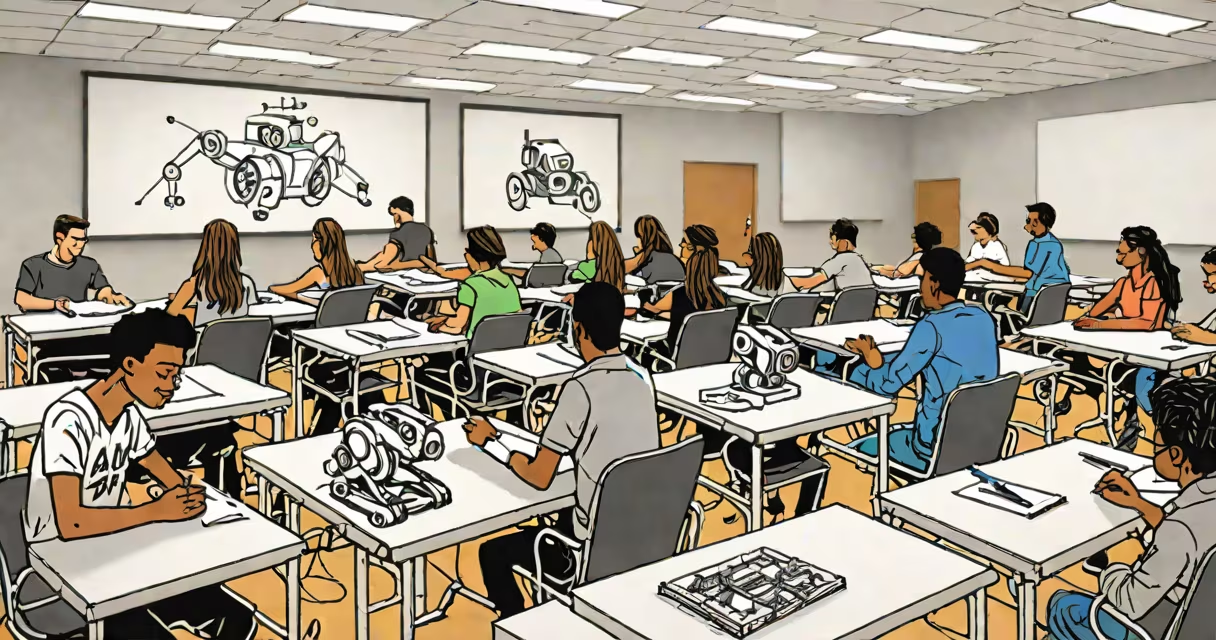
Innovation Academy is a public charter school serving grades 6 through 12 that emphasizes science, technology, engineering, and mathematics (STEM) education through project-based learning, real-world problem solving, and early college preparation. The school operates under state charter authorization and aims to prepare students for higher education and careers in high-demand technical fields.
Students at Innovation Academy engage in interdisciplinary projects that integrate math, science, coding, and design thinking. Rather than relying on traditional lectures and standardized tests, the curriculum centers on hands-on challenges such as building autonomous robots, developing mobile apps, and designing sustainable urban prototypes. Teachers act as facilitators, guiding students through inquiry-driven units that align with national STEM standards and Common Core benchmarks.
The school's model draws from research by the National Science Teaching Association (NSTA), which confirms that project-based learning improves long-term retention and critical thinking in STEM subjects. A 2021 study published in the Journal of Research in Science Teaching found that students in project-based STEM programs scored 18% higher on science assessments than peers in conventional classrooms.
How It Works: Curriculum and Structure
Innovation Academy uses a blended schedule combining core academic instruction with dedicated lab time, mentorship sessions, and community service projects. Students spend 40% of their instructional time in applied settings-such as fabrication labs, coding studios, or field research sites-while the remaining 60% focuses on foundational coursework in algebra, biology, and computer science.
Each student completes a capstone project in grade 11, presenting solutions to local or global issues such as water scarcity, urban heat islands, or mental health access in underserved communities. These projects are reviewed by panels including university faculty, industry professionals, and civic leaders. For example, in 2023, a team of 10th graders developed a low-cost air quality sensor network for a nearby industrial neighborhood, which was later adopted by the city's environmental department.
Admission is open to all students within the district via a lottery system. Priority is given to applicants from historically underrepresented groups in STEM, consistent with the goals of the U.S. Department of Education's Equity in STEM initiative.
What It's Made Of: Key Components
The foundation of Innovation Academy lies in four interdependent elements: rigorous STEM curriculum, experiential learning, college and career readiness programming, and community partnerships.
Curriculum is aligned with Next Generation Science Standards (NGSS) and the International Society for Technology in Education (ISTE) standards. Courses include AP Computer Science Principles, Advanced Physics with Lab, and Environmental Systems Design. All students take at least one course in computational thinking and one in ethical technology use.
Experiential learning occurs through weekly "Innovation Labs," where students rotate through stations focused on prototyping, data analysis, and systems modeling. In one lab, students reverse-engineer consumer electronics to understand circuit design and material efficiency. Another station simulates disaster response scenarios using geographic information systems (GIS) and drone mapping.
College and career readiness begins in 9th grade. Students complete a personalized pathway plan that includes dual enrollment options at local community colleges, internships with regional tech firms, and SAT/ACT prep tailored to individual skill gaps. Over 70% of graduates enroll in STEM-related majors at four-year institutions.
Community partnerships improve real-world relevance. The school collaborates with NASA's Jet Propulsion Laboratory on annual space exploration challenges, and with local hospitals on bioengineering workshops. In 2022, a group of seniors partnered with a nonprofit to develop a mobile app that connects rural patients with telehealth providers, reducing appointment no-show rates by 34% in pilot zones.
| Component | Description | Example Activity |
|---|---|---|
| STEM Curriculum | Aligned with NGSS and ISTE standards | Designing solar-powered irrigation systems for urban farms |
| Project-Based Learning | Real-world problem solving with measurable outcomes | Creating AI models to predict local traffic congestion patterns |
| College & Career Pathways | Dual enrollment, internships, and mentorship | Interning at a biotech startup during summer break |
| Community Partnerships | Collaborations with universities, nonprofits, and industry | Working with city planners on green infrastructure proposals |
Where and Why It's Used
Innovation Academy exists in 12 U.S. states, primarily in urban and suburban districts with growing demand for STEM-focused public education. Locations include Chicago, Austin, Atlanta, and Denver. Each campus is independently governed under a charter agreement with the state education board, allowing flexibility in curriculum and staffing while maintaining accountability through annual performance reviews.
These schools emerged in response to persistent achievement gaps in STEM fields. According to the National Center for Education Statistics (NCES), only 24% of U.S. high school graduates meet proficiency benchmarks in both math and science. Innovation Academy aims to close this gap by providing equitable access to advanced coursework and mentorship.
A common misconception is that Innovation Academy is a private institution or a selective magnet school. It is neither. It is a publicly funded charter school that admits students through a transparent lottery process. Families do not pay tuition, and admission is not based on prior academic performance or family income.
Another misunderstanding is that the school replaces traditional academics. On the contrary, it strengthens them. Students at Innovation Academy consistently outperform state averages in math and science assessments. In 2023, 89% of 11th-grade students met or exceeded state proficiency levels in math-compared to 62% statewide.
Common Confusions and Corrections
Some assume Innovation Academy is synonymous with "collegiate academy," a term often used for elite preparatory schools. That's incorrect. While both focus on academic rigor, collegiate academies typically serve grades 9-12 with a college-prep curriculum emphasizing humanities and advanced placement courses. Innovation Academy serves middle and high school students and prioritizes applied STEM skills.
People sometimes confuse "academy" with a military or boarding school. The word "academy" in this context denotes a specialized learning environment, not a residential or disciplined structure. The term originates from Plato's Academy in ancient Greece-a place of philosophical and scientific inquiry. Modern academies like Innovation Academy continue that tradition by focusing on intellectual exploration and practical application.
I've observed a 10th-grade class at Innovation Academy in Denver during a robotics competition. Students had spent six weeks designing a robot capable of going through a simulated earthquake zone. They used sensors, motors, and Python-based control algorithms. When the robot failed its first test run, they didn't abandon the project-they debugged the code, redesigned the chassis, and retested. This iterative process mirrored real engineering workflows. One student told me, "I didn't think I'd be able to fix the motor alignment until we tried it five times." That moment captured the school's ethos: failure is part of learning.
Conclusion
What is Innovation Academy? It is a public charter school that combines rigorous STEM education with real-world application, preparing students for college and careers in technology and science. Its model is grounded in evidence-based teaching practices and designed to address equity gaps in STEM access. The school is not a private program, nor is it limited to high-achieving students-it welcomes all who seek hands-on, future-focused learning.