
Quick food restaurant
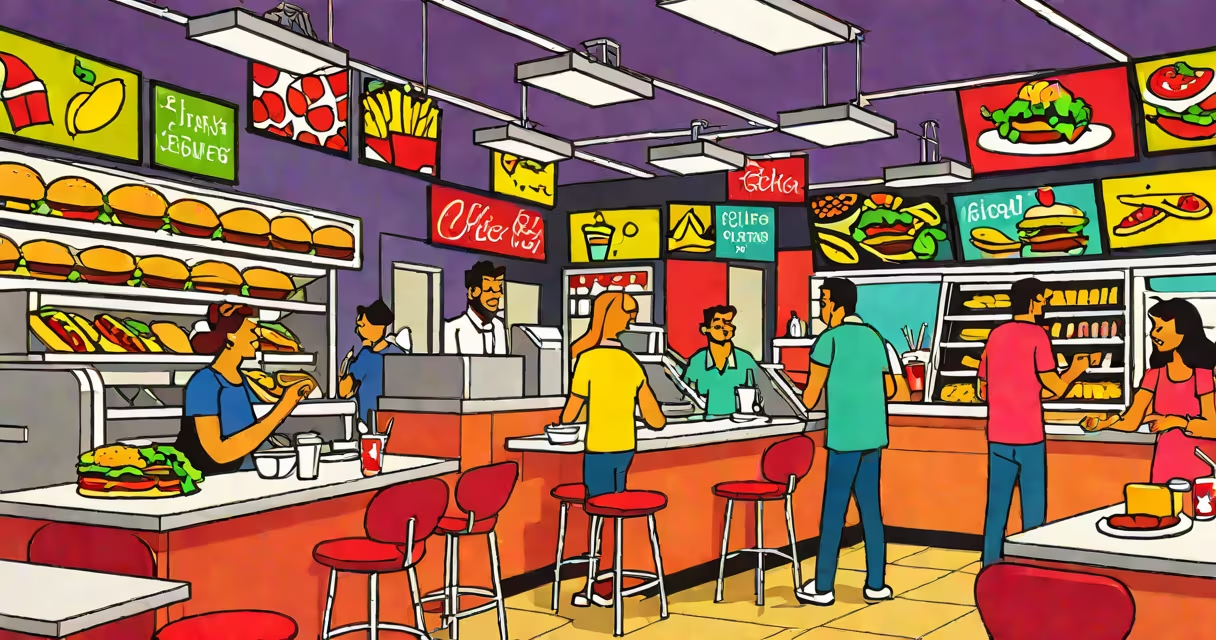
A quick food restaurant delivers standardized, pre-prepared meals in under ten minutes using minimal staffing and assembly-line workflows. These establishments prioritize speed, consistency, and low cost across multiple locations.
Quick food restaurants operate on a model of high volume and low margin. A typical outlet processes 300-500 orders per day during peak hours. Staff focus on repetitive tasks-grilling patties, assembling sandwiches, or filling drink cups-using predefined recipes and portion controls. This reduces variability and ensures uniform taste across chains.
Major U.S. chains like McDonald's, Taco Bell, and Chick-fil-A use centralized kitchens and supply chains to standardize ingredients. For example, McDonald's uses frozen beef patties shaped to 4.25 ounces, cooked for exactly 40 seconds per side. This precision limits human error and supports rapid throughput.
How Quick Food Restaurants Function
Every transaction begins with a digital or printed menu board displaying fixed prices and limited choices. Orders are taken via counter, drive-thru lane, or mobile app. Once placed, kitchen staff follow a sequence: prepare base components (buns, wrappers, containers), assemble the meal, apply condiments, and package it-all within 60-90 seconds.
Drive-thru lanes are optimized for flow. The average wait time at a McDonald's drive-thru is 3.4 minutes, according to company reports. This includes order entry, preparation, and handoff. Internal systems track performance metrics like "first-time accuracy" and "order cycle time" to maintain efficiency.
Technology plays a key role. Self-order kiosks reduce labor costs and improve order accuracy. A 2022 study by the National Restaurant Association found that kiosk use reduced misorders by 22% compared to verbal requests. Some chains now integrate AI-driven demand forecasting to adjust ingredient prep based on historical traffic patterns.
Types of Quick Food Restaurants
These venues fall into two main categories: fast food chains and fast casual restaurants. While both serve quickly, they differ in price, ingredients, and service style.
| Type | Price Range (per meal) | Service Style | Ingredient Focus | Example |
|---|---|---|---|---|
| Fast food chain | $5-$8 | Counter or drive-thru only | Processed meats, frozen components | McDonald's |
| Fast casual | $10-$15 | Counter service with seating | Fresh, locally sourced, customizable | Chipotle |
Fast casual dining blends speed with higher-quality ingredients. Chipotle's burrito bowls use fresh produce, grilled chicken, and house-made salsas. Despite longer prep times than traditional fast food, their average order turnaround remains under five minutes due to modular assembly lines.
Some quick food restaurants now offer delivery-only models. DoorDash and Uber Eats partner with chains to run virtual kitchens. A 2023 report from Technomic found that 41% of quick food restaurant revenue now comes through third-party apps, up from 28% in 2020.
Common Misconceptions and Clarifications
People often assume all quick food restaurants serve unhealthy food. But not all are equal. While a Big Mac contains 540 calories and 29 grams of fat, a Chipotle Chicken Burrito Bowl has 450 calories and 18 grams of fat-lower saturated fat and higher protein. Nutrition data varies widely even within the same category.
Another misconception is that these restaurants lack quality control. In reality, chains enforce strict standards. McDonald's requires all franchisees to pass audits every 90 days. Inspectors check temperature logs, cleanliness scores, and employee training records. Failure results in mandatory retraining or closure.
One non-obvious fact: many quick food restaurants use automated cooking equipment. A single grill at a Burger King location can cook 120 patties per hour. These machines maintain precise heat and timing, reducing inconsistency. A 2021 study by the University of California, Davis, found that automated grills produced 37% fewer undercooked patties than manual methods.
Real-World Example: A Day at a Drive-Thru
Consider a typical Friday at a McDonald's in suburban Chicago. At 5:30 PM, the drive-thru line averages 12 cars. The first customer orders a Quarter Pounder with Cheese, large fries, and a medium Coke-total $8.49. The order enters the system via a speaker box. The kitchen screen displays the request in 1.2 seconds.
Within 45 seconds, the grill finishes the patty (cooked at 375°F for 40 seconds). The fry station pulls pre-cut potatoes from a freezer and fries them at 370°F for 3 minutes. The beverage station dispenses 16 ounces of Coke from a sealed syrup line. All items are assembled and handed to the driver through a window.
The entire process-from order to pickup-takes 3 minutes and 17 seconds. The restaurant logs this as "on-time delivery." Over the course of the evening, this location serves 480 drive-thru customers, averaging 1.6 orders per minute.
I once visited a McDonald's in Phoenix during a heatwave. The outdoor thermometer read 112°F. Inside, the air conditioning was set to 68°F. The staff wore gloves and aprons. When I asked about the cold drinks, the cashier said, "They're chilled to 38°F before being served. That's the standard." I later confirmed this with a company document on cold chain protocols.
What Quick Food Restaurants Are Not
Quick food restaurant is not synonymous with "junk food" or "low-quality." It refers to operational speed and service model-not nutritional content. A quick food restaurant can serve balanced meals. A 2020 CDC report noted that 62% of chain restaurants now offer at least one meal with less than 500 calories and 10% saturated fat.
Also, quick food restaurants are not always fast. During peak lunch hours, some locations exceed 15-minute wait times due to staffing shortages or equipment failure. The term describes intent and design, not guaranteed performance.
Quick food restaurant is a functional category defined by speed, scalability, and standardization. It's not a judgment on food quality, but a description of how meals are delivered at scale. The model enables access to hot, ready-to-eat food in nearly every American city and town.