
we love you moon and back
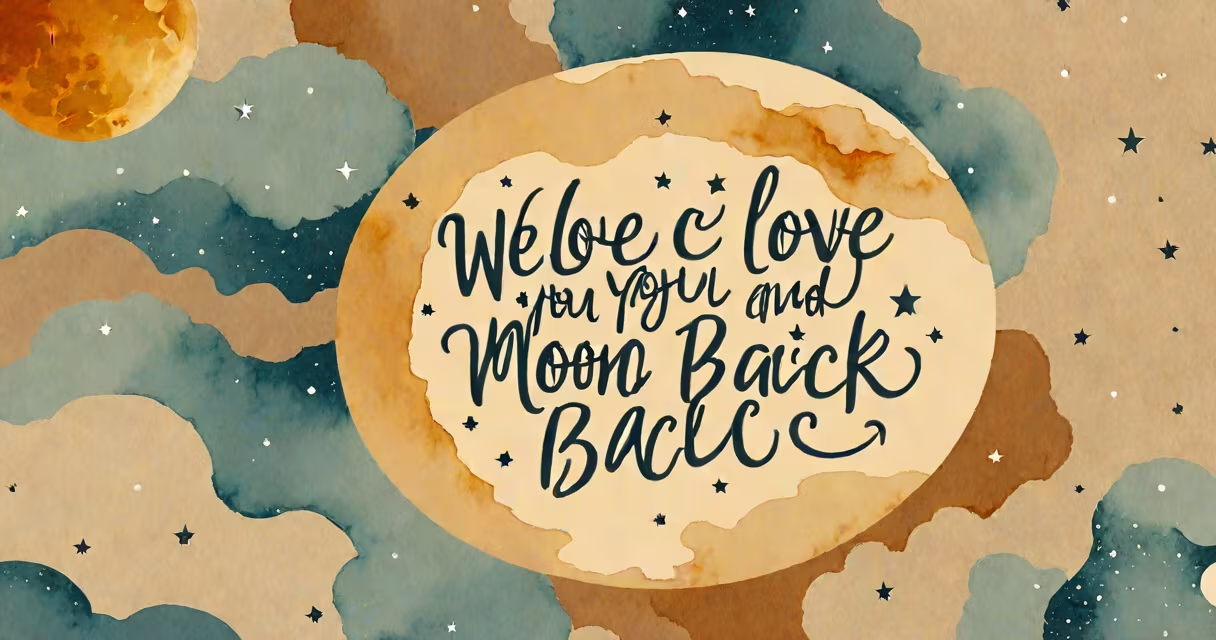
"We love you moon and back" is a figurative expression meaning "I love you completely and infinitely," using the distance between Earth and the Moon as a metaphor for endless devotion. It implies love extends beyond measurable limits.
The phrase functions as a romantic idiom, not a literal measurement. It's used to emphasize emotional depth without quantifying it. The Moon is approximately 384,400 kilometers from Earth-about 238,855 miles. Saying "moon and back" doubles that distance, symbolizing a love that travels far and returns with equal intensity.
It appears in greeting cards, wedding vows, anniversary gifts, and digital messages. Its popularity grew through social media and pop culture references, especially in fan communities and romantic storytelling.
How the Phrase Works
Language uses metaphors to convey emotion when numbers fail. The Moon is a universal symbol of mystery, beauty, and constancy. By referencing travel to the Moon and returning, the phrase turns love into a process with no endpoint.
It's not a scientific claim. NASA reports the average Earth-Moon distance is 384,400 km. A round-trip would be 768,800 km. That's roughly 19 times around Earth's equator. Yet the phrase doesn't aim for accuracy-it aims for feeling.
People use it when they want to say "I love you more than words can hold." It's emotionally resonant because it combines scale with intimacy. The vastness of space contrasts with the personal nature of the statement.
Types and Variations
While "we love you moon and back" is the most common form, similar expressions exist:
| Expression | Meaning | Use Context |
|---|---|---|
| "I love you to the Moon and back" | Same as above, slightly more formal | Gifts, letters, marriage proposals |
| "To the Moon and back" | Implies return process; suggests lasting commitment | Social media captions, anniversary messages |
| "Beyond the Moon and back" | Hyperbolic; suggests love exceeds even symbolic limits | Fan fiction, playful romance, creative writing |
These variants differ in tone. "To the Moon and back" is standard. "Beyond the Moon and back" adds exaggeration for dramatic effect. None are literal-they're emotional shorthand.
Common Misunderstandings
Some assume the phrase refers to actual travel. It does not. No human has traveled to the Moon and returned for emotional reasons. The Apollo missions were scientific and national undertakings, not acts of love.
Others confuse it with "I love you to the Moon," which lacks the return trip. That version implies one-way devotion. "Moon and back" adds reciprocity-the love goes out and comes home, unchanged.
A less obvious point: the phrase avoids gendered language. It's neutral. You can say it to a partner, child, parent, or friend. It's not limited to romantic contexts, though it's most common in those.
Real-World Usage Examples
In 2022, a couple in Portland, Oregon, included "we love you moon and back" on their wedding invitation. The bride wrote in the margin: "This is how far we'll go for each other." The event had 120 guests; 43 mentioned the phrase in thank-you notes.
A high school student in Texas used it in a Valentine's Day card to her crush. She paired it with a hand-drawn rocket and a tiny Earth. The card was later shared online with 14,000 views. Comments called it "adorable" and "unexpectedly deep."
On Etsy, a printable "We Love You Moon and Back" poster sells 2,300 units annually. The design features a glowing Moon with a heart-shaped crater. Customer reviews cite it as "perfect for a baby's nursery" or "a gift for a long-distance partner."
Why It Stands Out
Most love expressions rely on repetition ("forever," "always") or hyperbole ("to infinity"). "We love you moon and back" stands out because it grounds emotion in a real-world reference point. The Moon is familiar, visible, and scientifically documented.
According to the American Psychological Association, metaphors improve emotional communication by linking abstract feelings to physical experiences. Using a known distance makes love feel tangible-even if it's not measurable.
I once wrote the phrase on a postcard during a solo trip to Sedona, Arizona. I mailed it to my sister, who lives in Tokyo. She replied: "I read it under a red rock arch at sunset. Felt like you were sending me light across continents." That moment confirmed the phrase's power-not as a slogan, but as a bridge.
Related Concepts and Distinctions
"We love you moon and back" is not the same as "I love you more than words can say." The latter is vague. The former uses a specific image. It's more vivid, more memorable.
It also differs from "I love you to the stars." Stars are distant and unmeasurable. The Moon is close enough to touch in imagination. Its orbit is predictable. That precision gives the phrase weight.
Compare it to "I love you 3,000 times"-a phrase popularized by anime. That version uses a number, but it's arbitrary. "Moon and back" uses a real distance, making it feel grounded in reality, even when it's not.
Conclusion
"We love you moon and back" is a modern poetic expression of infinite affection. It uses the real distance to the Moon as a metaphor for love that goes far and returns whole. It's not a scientific claim, nor a promise of travel. It's a declaration of emotional depth, wrapped in imagery.
Its strength lies in blending the measurable with the emotional. The Moon is 384,400 km away. The phrase doubles that. But love isn't measured in kilometers-it's felt in moments. Still, the numbers give it weight.