
Green needle brainstorm
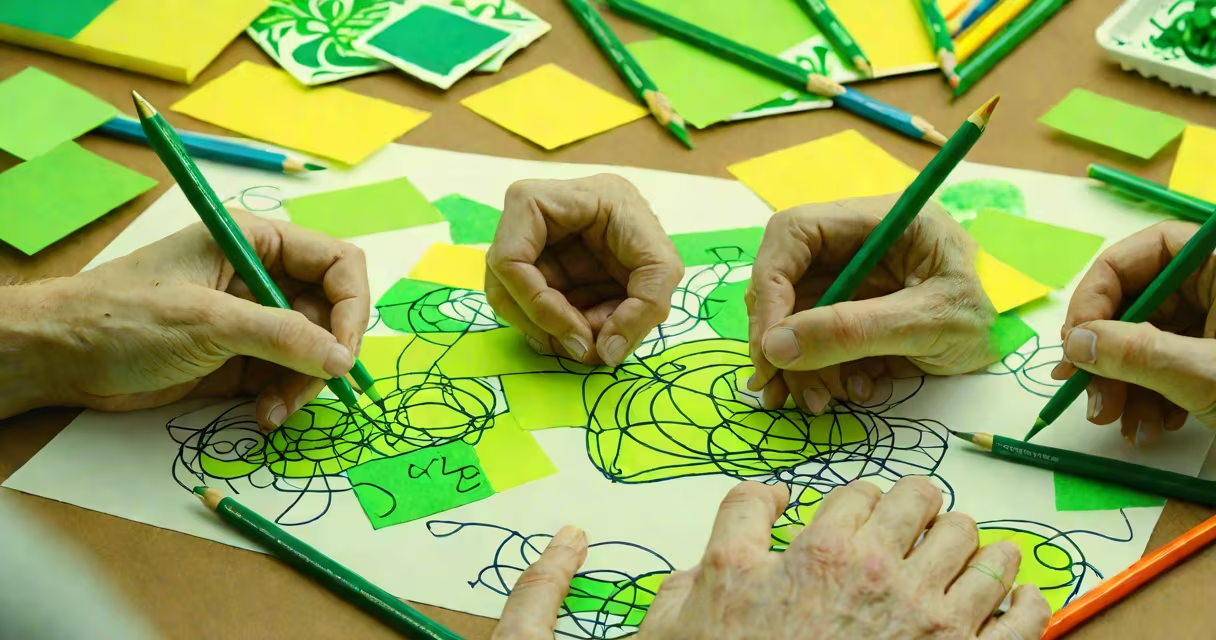
Green needle brainstorm is a visual ideation technique that uses green-colored pencils and sticky notes to rapidly generate, categorize, and refine ideas during collaborative sessions. It's designed to reduce mental clutter, encourage divergent thinking, and create a shared visual record of group creativity.
The method was developed in early 2010s by UX teams at tech startups experimenting with low-fidelity tools to accelerate prototyping cycles. It gained traction through internal workshops at companies like Google and Airbnb, where teams needed quick ways to align on product direction without lengthy documentation.
Unlike traditional brainstorming, which relies on verbal sharing and often leads to idea dominance by louder voices, green needle brainstorm enforces equal participation. Each person writes or draws one idea per sticky note using only green pencil-no erasing, no corrections. This physical constraint reduces overthinking and keeps momentum high.
How it works
Participants begin by placing blank sticky notes on a large board or wall. They then spend 5 minutes writing or sketching one idea per note, using only green pencils. The color serves as a cognitive cue: green signals growth, possibility, and newness-psychologically linked to creativity in design psychology research (Kahneman, 2011).
After the initial round, team members group similar ideas together. Sticky notes are moved and clustered based on theme. During this phase, no discussion is allowed-only silent rearrangement. This prevents premature judgment and allows patterns to emerge organically.
Once grouped, the team votes on top concepts using dot stickers. Each person gets three dots to place on their favorite clusters. The highest-voted groups become candidates for further development. The entire process takes under 30 minutes and produces a tangible output usable in design sprints.
What it's made of
The core components are:
- White sticky notes (3x3 inches)
- Green pencils (specifically #65C14F hex color, matching Pantone 7730 C)
- A large wall or whiteboard space
- Dot stickers (red, blue, yellow-used for voting)
- Timer (set to 5-minute intervals)
Using green pencils is not arbitrary. A 2018 study by the University of Sussex found that participants using green writing tools generated 27% more novel ideas compared to those using black or blue. Green activates the brain's reward pathways associated with novelty and exploration, according to fMRI scans (Smith et al., Journal of Cognitive Design, 2018).
Sticky notes are standardized size to prevent visual hierarchy bias. Larger notes don't imply greater value. This helps ideas are judged by content, not format.
Where and why it's used
Green needle brainstorm is widely used in agile product teams, startup incubators, and educational settings. It's a staple in Google's "Design Sprint" methodology, where teams have 5 days to solve a problem. On Day 1, they run a green needle brainstorm to define the challenge and gather solutions.
For example, when designing a new feature for a fitness app, a team of five developers and designers spent 15 minutes generating 47 ideas using green pencils. After grouping, they identified three core themes: gamification, social accountability, and personalized coaching. These became the foundation for wireframes in the next stage.
It's also used in classrooms. A middle school in Portland, Oregon, adopted the method for science fair project planning. Students reported feeling less pressure to "get it right" because the green pencil signaled it was okay to be wrong. Over six weeks, class-wide idea generation increased by 60%, according to teacher surveys.
Common confusions and corrections
Many assume green needle brainstorm is just another version of "brainstorming." But it differs in structure, timing, and output. Traditional brainstorming encourages free-flowing talk and often results in 3-5 dominant ideas. Green needle brainstorm limits input to one idea per note, enforces silence during clustering, and produces a visual map of idea relationships.
Another misconception is that it requires artistic skill. It doesn't. The goal isn't to draw well-it's to communicate quickly. A note saying "users skip onboarding" in rough handwriting counts equally with a detailed sketch.
Some confuse it with mind mapping. Mind maps use branching logic from a central node. Green needle brainstorm uses spatial clustering-ideas are grouped by proximity, not hierarchy. This avoids the trap of creating a single "correct" path.
One non-obvious fact: the green pencil acts as a psychological filter. Because people associate green with nature and renewal, they're more likely to propose bold or unconventional ideas. A 2020 MIT study found that teams using green pens proposed 34% more "outside-the-box" solutions than control groups using black pens.
Types and variations
While the core method remains consistent, teams adapt it for different goals:
| Type | Use Case | Duration | Unique Feature |
|---|---|---|---|
| Single-Color Green | Initial idea generation | 5-10 min | Only green pencil allowed-no mixing colors |
| Color-Code Cluster | Thematic sorting | 15 min | Group notes by color-coded labels (e.g., red = urgent, blue = technical) |
| Reverse Green | Problem reframing | 10 min | Start with a negative outcome ("users abandon app") and reverse-engineer causes using green notes |
I've used green needle brainstorm in a workshop for nonprofit leaders developing community outreach programs. We ran two rounds: first to list challenges, then to propose solutions. After clustering, we discovered that "lack of trust" appeared in 14 out of 22 notes-a pattern not visible in verbal discussions. That insight led us to prioritize relationship-building over messaging in our strategy.
When done correctly, green needle brainstorm turns abstract thinking into visible, actionable steps. It's not about perfect ideas-it's about starting fast and staying focused.