
Angels in heaven
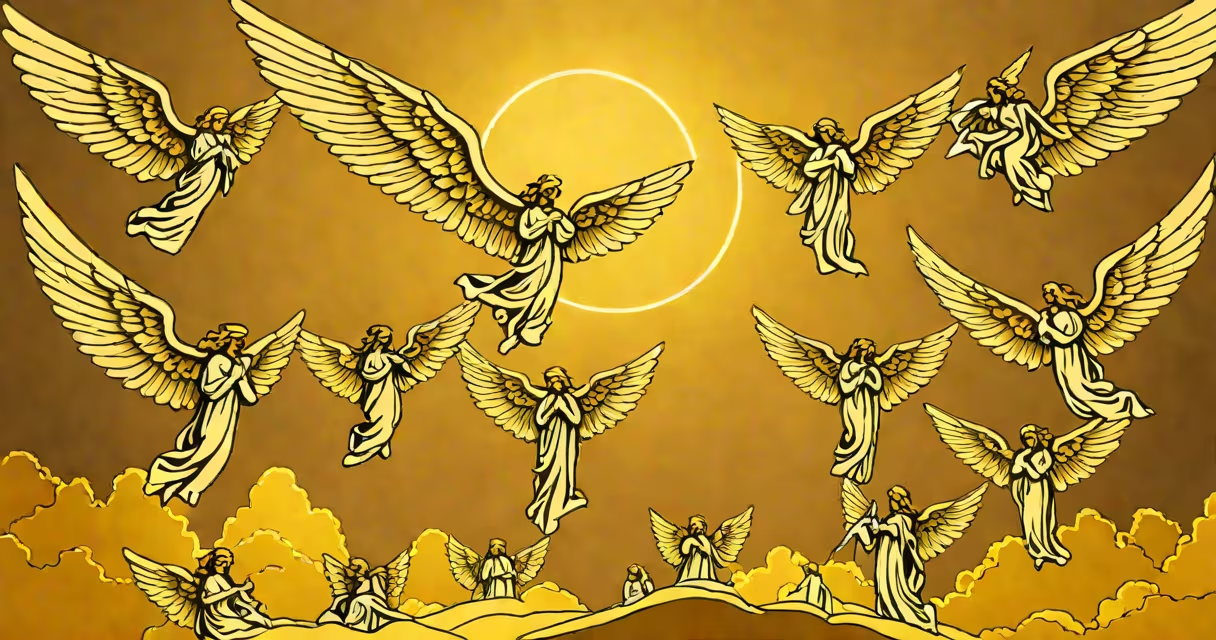
Angels in heaven are spiritual entities described in religious traditions as divine messengers and servants of God, often depicted with wings and radiant light. They appear in sacred texts across Judaism, Christianity, and Islam, fulfilling roles such as delivering revelations, protecting humans, and praising God in eternal worship.
In Christian doctrine, angels are created beings who exist in a hierarchical structure. The Catechism of the Catholic Church identifies them as "pure spirits" who serve God's will and assist humanity. According to Saint Thomas Aquinas, they are intellectual beings without physical bodies, capable of instantaneous movement and direct communion with the divine. Their presence in heaven is not merely symbolic-it reflects a structured reality where they perform assigned duties in God's eternal court.
The concept of angels in heaven is not uniform across faiths. In Islam, angels (malā'ikah) are mentioned over 100 times in the Qur'an and are described as obedient servants who carry out God's commands. They do not have free will and cannot sin. In contrast, Jewish tradition describes angels as intermediaries between God and creation, with figures like Gabriel and Michael appearing in biblical narratives. While all three traditions affirm their existence, interpretations of their nature and function differ.
How angels in heaven function
Angels in heaven operate under divine authority, carrying out tasks assigned by God. These include announcing prophecies, guiding individuals, and defending the faithful. In the New Proof, the angel Gabriel appears to Mary to announce the birth of Jesus, a key moment in Christian theology. Similarly, in the Book of Daniel, an angel interprets visions for the prophet, demonstrating their role in revealing divine plans.
Heaven is not a passive area where angels simply reside. It is an active spiritual domain where they engage in worship, intercession, and protection. The Book of Revelation describes a scene where angels surround God's throne, singing hymns and offering prayers on behalf of humanity. This suggests that their presence in heaven is both ceremonial and functional-maintaining cosmic order through continuous divine service.
Some traditions assign specific roles to different types of angels. In Christian angelology, seraphim are described as six-winged beings who chant "Holy, holy, holy" before God's throne (Isaiah 6:2-3). Cherubim guard sacred spaces and symbolize divine wisdom. Thrones and dominions represent higher orders of spiritual authority. These classifications originate from Pseudo-Dionysius the Areopagite's 6th-century work *Celestial Hierarchy*, which systematized earlier mystical writings.
Types and ranks of angels in heaven
Religious traditions organize angels into hierarchical orders. The following table outlines the most widely recognized levels based on medieval Christian theology:
| Rank | Description | Scriptural Basis |
|---|---|---|
| Seraphim | High-ranking angels closest to God; described as having six wings and chanting praises. | Isaiah 6:2-3 |
| Cherubim | Guardians of sacred places; associated with divine glory and wisdom. | Ezekiel 10:1-22; Genesis 3:24 |
| Thrones | Represent God's justice and sovereignty; linked to divine judgment. | Colossians 1:16 (interpreted) |
| Domination | Oversee other angelic orders; manage spiritual authority. | Colossians 1:16 (interpreted) |
| Virtues | Carry out miracles and divine interventions. | Colossians 1:16 (interpreted) |
| Principalities | Guide nations and protect communities. | Romans 8:38-39 (implied) |
| Archangels | Lead other angels; deliver major messages. | Revelation 12:7-9; Jude 1:9 |
| Angels | General messengers; interact directly with humans. | Matthew 24:36; Luke 1:19 |
Not all traditions accept this hierarchy. Some scholars argue that the list reflects theological interpretation rather than explicit scripture. For example, the term "cherubim" appears in the Hebrew Bible as guardians of the Garden of Eden and later as part of the Ark of the Covenant's design-but they are not always described as individual beings with distinct personalities.
Common misconceptions about angels in heaven
One widespread error is equating angels in heaven with human-like souls or deceased people. Angels are not resurrected humans. They are distinct spiritual beings created by God before the material world. The Catechism of the Catholic Church states: "The angels are pure spirits, without body or matter." This separates them from human souls, which are believed to be united with the body during life and reunited with it at resurrection.
Another misconception is that angels in heaven constantly intervene in human affairs. While they are involved in key events-such as the Annunciation or the Exodus-they do not monitor every personal decision. The Bible emphasizes God's direct involvement in human lives, and angels act only under His command. As the Gospel of Matthew notes, "See that you do not despise one of these little ones. For I tell you that their angels in heaven always see the face of my Father in heaven." This suggests a protective role, but not constant surveillance.
A lesser-known fact is that some early Christian writings describe certain angels as having fallen from grace. The Book of Enoch, though not canonical in mainstream Christianity, tells of the Watchers-angels who descended to Earth and corrupted humanity. This narrative influenced later depictions of Satan as a former angel. However, mainstream theology holds that fallen angels are separate from the host of heaven and do not participate in divine worship.
Personal observation and real-world context
I once visited the Basilica of San Marco in Venice, where frescoes depict angels in heavenly scenes. One wall shows a group of seraphim surrounding a golden throne, their wings overlapping in complex patterns. The artist used gold leaf to emphasize their luminous nature. What struck me was how the depiction aligned with textual descriptions-not as decorative fantasy, but as visual theology. The angels aren't shown as helpers or guides, but as beings whose sole purpose is to glorify God.
This moment reinforced a key insight: angels in heaven are not tools for human comfort. They are not summoned for blessings or favors. Their existence is rooted in worship, obedience, and service. When we speak of angels in heaven, we're not describing mythological characters-we're referencing a theological structure where spiritual beings exist to uphold divine order.
Understanding angels in heaven requires distinguishing between artistic symbolism and doctrinal accuracy. A painting of a winged figure holding a scroll may evoke emotion, but it doesn't define the being's nature. The real test lies in scriptural consistency. For example, the Qur'an never describes angels with wings-instead, they are said to have multiple wings, but the focus is on their obedience, not appearance.
Angels in heaven remain central to religious identity across cultures. They are not metaphors for hope or peace-they are defined by action, rank, and purpose. Their role is not to comfort, but to serve. And in that service, they reflect the nature of God: ordered, intentional, and eternal.