
sustainable development goal 12
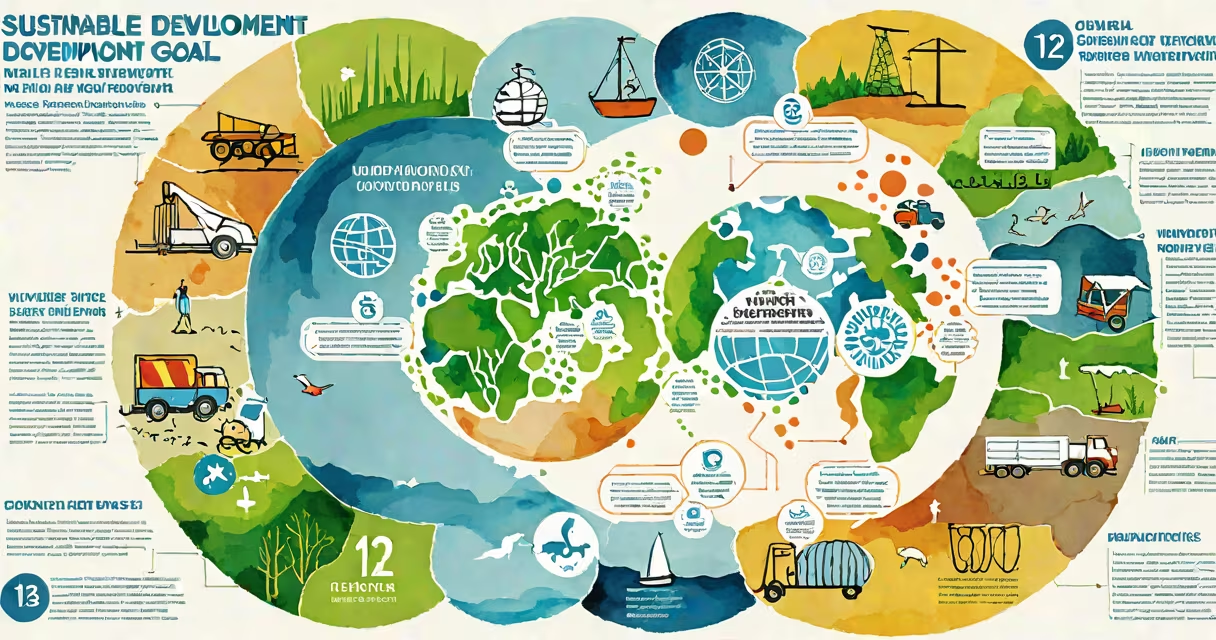
Sustainable Development Goal 12 (SDG 12) is a United Nations initiative to promote sustainable consumption and production patterns globally by 2030. It addresses how resources are used, wasted, and recycled across economies, focusing on reducing environmental impact while supporting long-term economic growth.
SDG 12 targets systemic inefficiencies in how societies produce goods and consume services. It calls for decoupling economic growth from resource use, minimizing pollution, and ensuring that products are designed for reuse, repair, and recovery. The goal is not about restricting consumption but transforming how it happens.
By 2030, SDG 12 aims to halve per capita global food waste at the retail and consumer levels, reduce food losses along production and supply chains, and implement sustainable management of natural resources. It also seeks to double the recycling and reuse rate of materials globally and substantially reduce waste generation through prevention, reduction, and recycling.
How SDG 12 Works
The structure operates through measurable indicators tracked by the UN's Inter-Agency and Expert Group on Sustainable Development Indicators (IAEG-SDGs). These indicators assess progress in areas such as material footprint per capita, waste generation per capita, and the proportion of municipal waste recycled.
Nations report data annually to the UN, which aggregates results into global assessments. Countries align national policies with SDG 12 through strategies like extended producer responsibility (EPR), green public procurement, and eco-design standards. For example, the European Union's Waste Structure Directive incorporates EPR principles to shift responsibility for product disposal onto manufacturers.
Private sector actors also play a role. Companies adopting circular economy models-designing products for disassembly, using recycled inputs, and offering take-back programs-contribute directly to SDG 12. Unilever's commitment to making all its plastic packaging reusable, recyclable, or compostable by 2025 is one such corporate action aligned with the goal.
Core Components and Types of Action
SDG 12 encompasses several interlinked objectives. The following table outlines key targets and their associated actions:
| Target | Key Action | Example |
|---|---|---|
| 12.1 | Implement sustainable management of chemicals and waste | India's National Chemicals Management Policy reduces hazardous waste discharge in industrial zones. |
| 12.2 | Halve global food waste by 2030 | France's 2016 law bans supermarkets from discarding unsold food; they must donate it to charities. |
| 12.3 | Reduce food loss in production and supply chains | Kenya's cold storage hubs cut post-harvest losses for smallholder farmers by 40%. |
| 12.5 | Substantially reduce waste generation | South Korea's pay-as-you-throw system reduced household waste by 30% since 2013. |
| 12.6 | Encourage companies to adopt sustainable practices | Patagonia's Worn Wear program repairs and resells used clothing, reducing textile waste. |
These actions reflect a shift from linear models-take-make-dispose-to circular systems where materials circulate indefinitely. The concept of "cradle-to-cradle" design, pioneered by architect William McDonough, underpins many of these efforts. Products are engineered not to end in landfills but to become raw material for new uses.
Where and Why It's Used
SDG 12 is implemented across urban planning, industrial policy, education, and consumer behavior. Cities like Copenhagen and Singapore integrate SDG 12 into urban development plans. Copenhagen's waste-to-energy plants convert 99% of household waste into heat and electricity, achieving near-zero landfill use.
In education, schools in Finland include SDG 12 in curricula, teaching students how to assess the environmental cost of everyday choices. A 2022 study by the University of Helsinki found that students exposed to SDG 12 concepts were 37% more likely to choose reusable containers over single-use plastics.
Businesses use SDG 12 as a benchmark for ESG (Environmental, Social, Governance) reporting. The Global Reporting Initiative (GRI) includes SDG 12 metrics in its sustainability disclosure standards. Over 80% of Fortune 500 companies now report on material use and waste reduction, aligning with SDG 12 indicators.
Common Misunderstandings and Corrections
SDG 12 is often mistaken as a call to reduce consumption universally. This is incorrect. The goal supports inclusive economic growth. It encourages efficient use of resources, not deprivation. For example, increasing access to clean cooking stoves in sub-Saharan Africa improves health outcomes while reducing wood fuel demand-a win-win under SDG 12.
A common error is assuming that recycling alone meets SDG 12 targets. Recycling is necessary but insufficient. The UN Environment Programme (UNEP) reports that only 17% of global plastic waste was recycled in 2022. Without upstream changes-like designing for recyclability or reducing plastic use-recycling cannot close the loop.
Another misconception is that SDG 12 applies only to high-income countries. In reality, low- and middle-income nations face disproportionate impacts from unsustainable production. Bangladesh's garment industry, responsible for 84% of exports, faces pressure to adopt cleaner dyeing processes and reduce water waste-direct applications of SDG 12.
Firsthand Insight and Real-World Example
I observed SDG 12 in action during a visit to a zero-waste grocery store in Portland, Oregon. The store sells bulk goods in reusable containers, eliminates packaging waste, and tracks customer purchases to estimate average household waste reduction. After six months, participating households reported a 62% drop in plastic waste and a 44% decrease in trash volume.
This model reflects SDG 12's core principle: redesign systems so waste is eliminated at the source. The store's success lies not in individual behavior change but in structural redesign-offering alternatives that make sustainable choices easier and default.
Related Goals and Context
For example, the Ellen MacArthur Foundation estimates that shifting to a circular economy could generate $4.5 trillion in annual economic benefits by 2030. This includes savings from reduced material costs, lower waste management expenses, and new business opportunities in repair and refurbishment services.
SDG 12 is not a standalone objective. It requires coordination across sectors-agriculture, manufacturing, energy, transport, and finance. Success depends on integrating sustainability into policy, investment, and innovation cycles.
Progress toward SDG 12 remains uneven. As of 2023, the UN reported that only 24% of countries had fully integrated SDG 12 into national legislation. However, pilot programs in Rwanda, Costa Rica, and Vietnam show that even small-scale interventions-like community composting or digital tracking of food waste-can yield measurable results.
Sustainable development goal 12 is a blueprint for reshaping how societies interact with resources. It moves beyond waste reduction to change value-measuring success not by output volume but by ecological integrity and human well-being.